
Tent AC Capacity: How Many Tons Do You Need?
In this article
- The Short Answer
- What You Should Know Before Booking
- Why Floor Area Alone Is Not Enough
- Understanding Cooling Tons and BTU
- The Calculation Formula
- Effect of Tent Height
- Sun, Insulation and Roof Color
- Effect of Guest Numbers
- Frequently Opened Doors and Air Leakage
- Heat from Lighting and Catering Equipment
- Example: A 100 m² Tent
- Estimated Table for Common Tent Sizes (Summer)
- When a Package (Floor-Standing) AC Is the Right Choice
- Distributing Air Instead of One Big Unit
- Electrical Capacity and Operation
- Common Quick-Calculation Mistakes
- Information to Send Your AC Provider
- Testing Cooling Before the Event
- Tent AC Capacity by Event Type
- Open and Semi-Open Tents
- Cooling Condolence Tents
- Tent Cooling Across Kuwait
- Factors That Affect the Cost
- Tips for Better Cooling with the Same Capacity
- Practical Examples
- How to Choose the Best Offer from RentalKW
- Frequently Asked Questions
- Conclusion
Choosing the right AC capacity for a tent is one of the decisions that most determines the success of any summer event in Kuwait. A tent that looks beautiful in photos can become stifling if the cooling is undersized, and guests will remember the heat far more than the decor.
The question that always comes up is: how many tons of AC does the tent need? The answer does not depend on floor area alone. It depends on the number of guests, the time of the event, the tent fabric, its height and how often the doors open.
This guide gives you a simple formula to calculate tent AC capacity, a ready table for common tent sizes, and the most common mistakes that leave a tent under-cooled.
The Short Answer
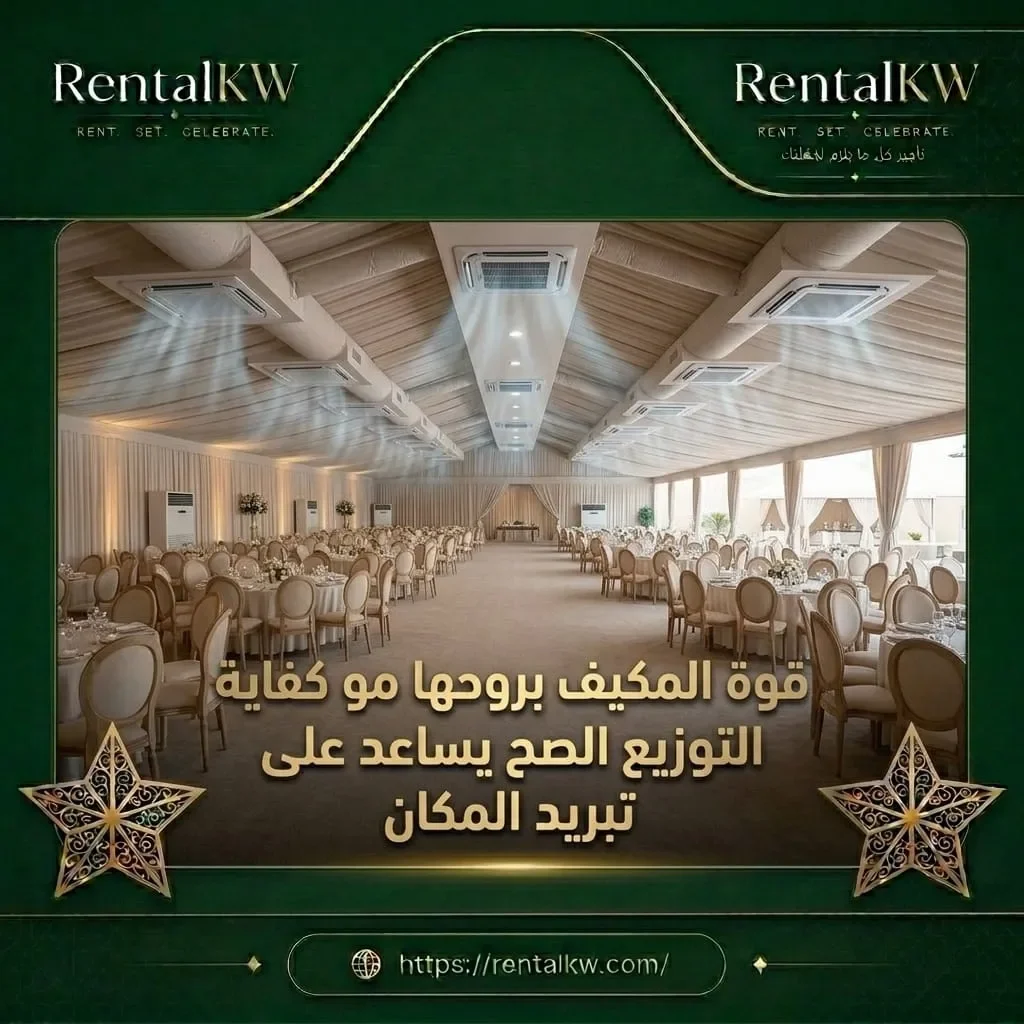
In a Kuwaiti summer a tent needs roughly one ton of cooling per 10 m², plus one ton per 25 guests at peak time. In spring and autumn the need drops to about one ton per 15 m². This is an estimate; the final figure should be reviewed against site conditions.
What You Should Know Before Booking
Prepare the tent size (length × width) and height, expected guests at peak, event date and time (noon, afternoon or night), available power or the need for a generator, and whether the tent has a hot buffet or strong lighting.
Why Floor Area Alone Is Not Enough
Two tents of the same size can need very different cooling. A 100 m² tent with 30 people at night in March is not the same as a 100 m² tent with 90 people at noon in July. The right AC capacity for a tent is calculated from the sum of solar heat on the roof and walls, body heat from guests, hot air entering through doors, and heat from lighting and equipment.
Understanding Cooling Tons and BTU
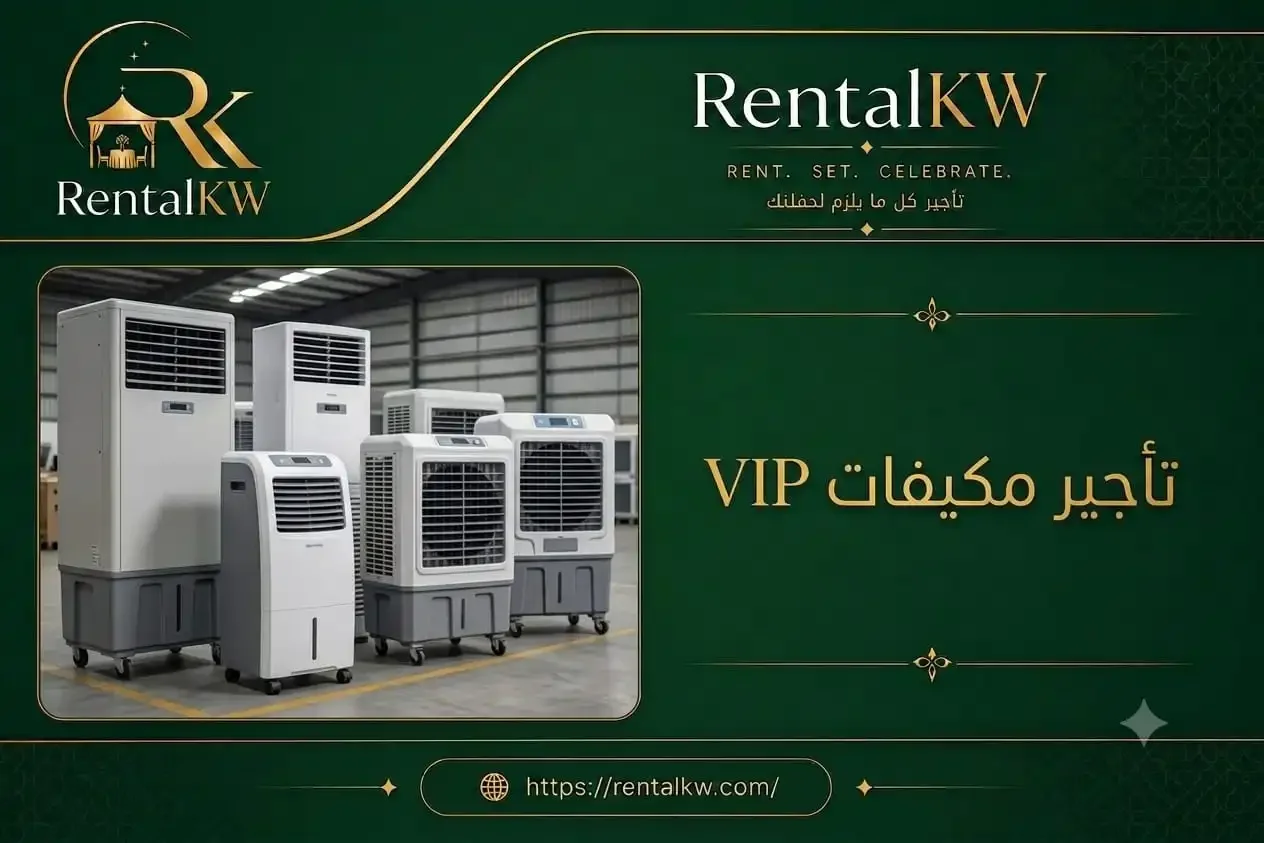
A cooling ton measures the AC’s ability to remove heat, not the unit’s weight. One ton equals 12,000 BTU per hour. A 5-ton unit equals 60,000 BTU, and a 10-ton unit equals 120,000 BTU. When a tent needs 20 tons, that could be four 5-ton units or two 10-ton units, depending on availability and air distribution.
The Calculation Formula
Tons = (tent area in m² ÷ 10) + (peak guests ÷ 25)
In spring and autumn, use ÷ 15 instead of ÷ 10 for the first part.
Effect of Tent Height
The formula assumes sidewalls of about 3 m. The higher the roof, the more air needs cooling. With sidewalls of 4 m or more, or a high peaked roof, add 10 - 20% to the tonnage.
Sun, Insulation and Roof Color
Tent walls are fabric or PVC with weak insulation compared to house walls. A white roof reflects more solar heat than dark colors, a lined tent needs less cooling, and a tent in full sun all day needs more capacity than one shaded by a building or trees.
Effect of Guest Numbers
Each person gives off about 400 - 500 BTU per hour. Every 25 people add close to one ton of cooling. At crowded weddings and gatherings this share can be large, so never calculate on floor area alone.
Frequently Opened Doors and Air Leakage
Every time the tent door opens, hot air enters. At condolences and weddings guests come and go constantly. Use a double-curtain entrance or a small vestibule, add 10% to the tonnage when traffic is heavy, and keep side doors closed.
Heat from Lighting and Catering Equipment
Old chandeliers, strong spotlights, hot buffets, tea and coffee urns all add heat. LED lighting reduces the load, and placing the preparation area outside the tent or in a separate annex keeps heat away from guests.
Example: A 100 m² Tent
A 10 × 10 m tent for a summer gathering with 60 guests at peak:
-
Area: 100 ÷ 10 = 10 tons
-
Guests: 60 ÷ 25 = 2.4 tons
-
Total: about 12.4 tons, roughly three units of 4 - 5 tons each.
For a night gathering in April: 100 ÷ 15 = 6.7 + 2.4 = about 9 tons.
Estimated Table for Common Tent Sizes (Summer)
|
Tent size |
Area |
Area load |
With approx. guests |
Approx. total |
|---|---|---|---|---|
|
5 × 10 m |
50 m² |
5 tons |
25 people (+1 ton) |
6 tons |
|
10 × 10 m |
100 m² |
10 tons |
60 people (+2.5 tons) |
12.5 tons |
|
10 × 20 m |
200 m² |
20 tons |
120 people (+5 tons) |
25 tons |
|
15 × 30 m |
450 m² |
45 tons |
250 people (+10 tons) |
55 tons |
|
20 × 40 m |
800 m² |
80 tons |
450 people (+18 tons) |
98 tons |
When a Package (Floor-Standing) AC Is the Right Choice
|
Type |
Advantages |
Drawbacks |
Best for |
|---|---|---|---|
|
Package floor-standing AC |
Strong, stable cooling; works in humidity |
Needs high power or a generator |
Closed tents and summer weddings |
|
Evaporative (desert) cooler |
Lower power use; suits open spaces |
Weak in high humidity; needs water refills |
Semi-open seating and dry weather |
In August and September humidity rises in Kuwait and evaporative coolers lose effectiveness, so package units are the safer choice for closed tents.
Distributing Air Instead of One Big Unit
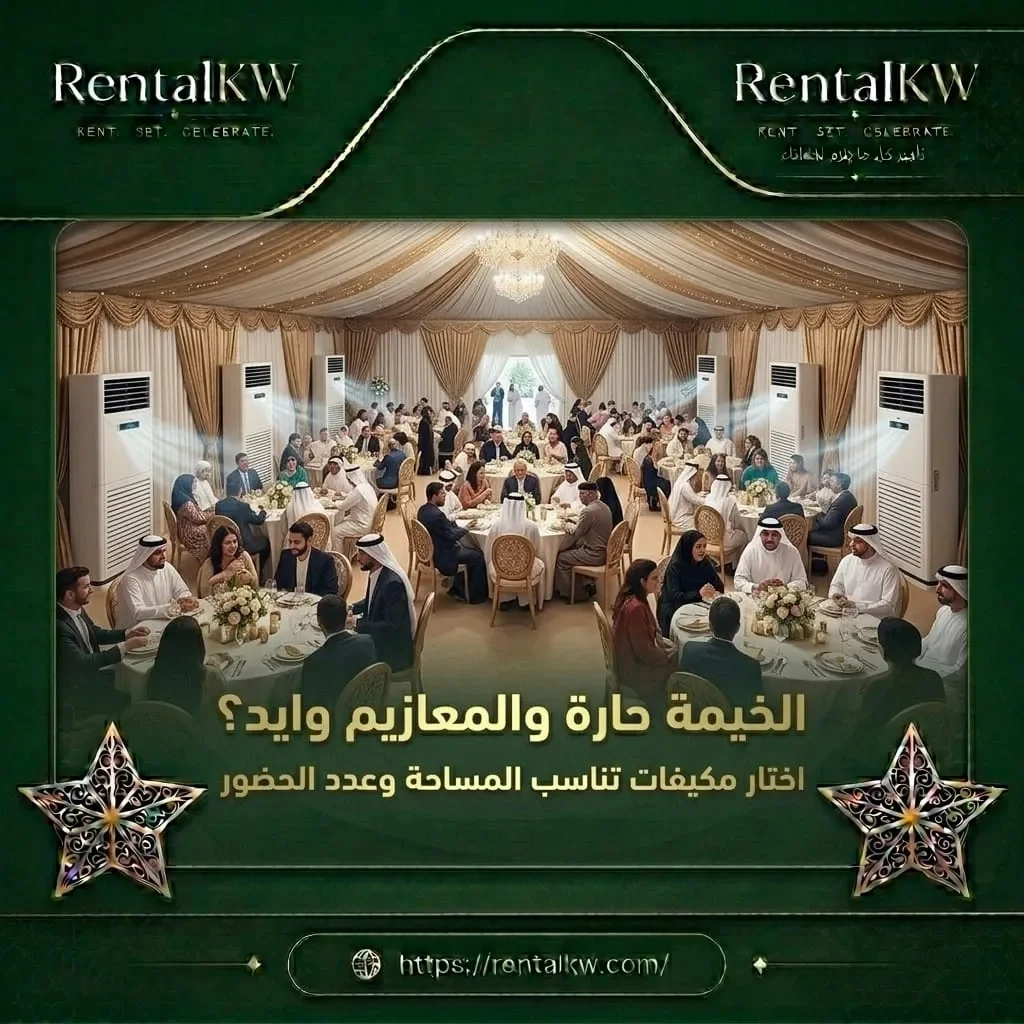
One large unit in a corner makes one side very cold and the other hot. Instead, spread several units along the tent sides, aim outlets at seating rather than the entrance, keep units away from the buffet so food does not cool too fast, and use air ducts in large tents to distribute cooling.
Electrical Capacity and Operation
Each ton of cooling needs roughly 1.2 - 1.5 kW. A tent needing 25 tons may draw 30 - 40 kW, which a normal house line cannot supply. Most medium and large tents need a suitably sized generator with about 20% spare capacity.
Common Quick-Calculation Mistakes
-
Calculating on area only and ignoring guests.
-
Using room sizing (one ton per 15 - 20 m²) for a tent.
-
Relying on evaporative coolers in a closed summer tent.
-
Switching on the AC only minutes before guests arrive.
-
Forgetting generator capacity, so power trips mid-event.
Information to Send Your AC Provider
-
☐ Tent size, height and roof color
-
☐ Number of guests at peak
-
☐ Event date and time
-
☐ Power source or generator need
-
☐ Any hot buffet or strong lighting
-
☐ Site photos and where the units will go
Testing Cooling Before the Event
Run the AC at least one to two hours before guests arrive in summer so the floor, fabric and furniture cool down. Make sure the generator can run all units together and that air reaches the farthest seat.
Tent AC Capacity by Event Type
|
Event type |
What sets it apart |
Suggested adjustment |
|---|---|---|
|
Wedding |
Large crowd, strong lighting, dancing |
Add 15 - 20% |
|
Condolence |
Continuous coming and going for hours |
Add 10% for doors |
|
Evening gathering |
Stable attendance, long sitting |
Base calculation usually enough |
|
Women’s milcha |
Dense attendance in a short time |
Count peak guests accurately |
|
Events and exhibitions |
Changing visitors and screens |
Add heat from equipment |
Open and Semi-Open Tents
An open-sided tent cannot be cooled effectively with package units because cold air escapes immediately. Use evaporative coolers on dry days, close sun-facing sides with tent curtains, use misting fans in open seating, and schedule the event after sunset if possible. For real summer cooling, the tent must be closed.
Cooling Condolence Tents
A condolence tent runs for long hours over three days. Count mourners at peak (usually after maghrib), add 10% for doors, start the AC from noon if the condolence begins in the afternoon, and secure generator fuel for three consecutive days.
Tent Cooling Across Kuwait
-
Jahra and desert areas: higher daytime heat and more dust, needing extra capacity and clean filters.
-
Ahmadi Governorate: courtyard, farm and chalet tents, with summer humidity near the coast.
-
Capital Governorate: condolence and gathering tents next to homes, usually needing a generator.
-
Hawalli Governorate: tighter spaces, better served by several medium units than one large unit.
-
Farwaniya Governorate: medium tents for gatherings and condolences in nearby plots.
-
Mubarak Al-Kabeer Governorate: courtyard tents, with the generator placed away from neighbors.
Factors That Affect the Cost
-
Required tonnage, the biggest factor.
-
AC type: package or evaporative.
-
Generator capacity, fuel and operating hours.
-
Rental period: one day, three days or a week.
-
Installation and ducting in large tents.
-
Season: peak summer demand means early booking.
Tips for Better Cooling with the Same Capacity

-
Choose a white-roofed, lined tent.
-
Use raised flooring or carpet to reduce ground heat.
-
Close unused openings.
-
Keep the hospitality area and hot buffet outside the main tent.
-
Use LED instead of old spotlights.
-
Start the AC early rather than adding capacity.
Practical Examples
A 10 × 20 m condolence tent in July: 20 tons for area + 6 tons for 150 mourners = 26 tons, plus 10% for doors = about 28.6 tons, e.g. six 5-ton package units with a generator for three days.
A 15 × 30 m wedding tent in September: 45 + 10 = 55 tons, plus 15% for lighting and movement = about 63 tons, using large package units with ducts.
A 6 × 10 m night gathering in April: 60 ÷ 15 = 4 + 1.6 = about 5.6 tons, e.g. two 3-ton units, or evaporative coolers if the air is dry.
How to Choose the Best Offer from RentalKW
Ask for an offer stating the number of units and each unit’s tonnage, AC type, whether the generator and installation are included, and the rental period. You can combine AC with tent rental in one booking.
Frequently Asked Questions
Is the right tent AC capacity the same for every event?
No. It varies with guests, time of day and season; a spring night gathering needs far less than a summer noon wedding.
How do I determine the capacity I need?
Use area ÷ 10 + guests ÷ 25, then add 10 - 20% for a high roof or heavy traffic.
What information should I prepare?
Tent size and height, guest count, date and time, power source and site photos.
Can AC be combined with other setups?
Yes, with the tent, generator, sofas and tables in one booking.
How do I make sure it is ready on the day?
Run it one to two hours before guests and check the generator and airflow to all seating.
Is a ton the weight of the unit?
No, it is a unit of cooling capacity equal to 12,000 BTU per hour.
Why does a tent stay hot despite many units?
Usually late start-up, constantly open doors, a dark roof, or an undersized generator running units below capacity.
Can split ACs be used in a tent?
They can be used in semi-permanent tents but take longer to install. For temporary events, portable package units are preferred because they are quicker to install and remove.
How many units do I need for a 10 × 20 m tent?
About 25 tons in summer with 120 guests, which is roughly five 5-ton package units spread along the sides of the tent.
Does an evaporative cooler need water?
Yes. It works by evaporating water, so its tank must be refilled regularly or connected to a water supply, and its performance drops as humidity rises.
Is the house AC enough if the tent is attached to the house?
No. Opening the house door into the tent draws cool air out of the house, strains its units and still will not cool the tent. Calculate a separate capacity for the tent.
How long before the event should the AC be switched on?
At least one to two hours in summer, so the floor, fabric and furniture have time to cool down before guests arrive.
Conclusion
Choosing the right AC capacity for a tent starts with a simple rule: one ton per 10 m² in summer and one ton per 25 guests. Then adjust for height, sun, doors and lighting, choose package units for closed tents, spread air across several units and confirm generator capacity.
Book tent cooling now: AC rental page
To book or inquire: use the contact numbers listed on rentalkw.com