Matrouq Sofa Rental Based on Majlis Size
In this article
- Matrouq Sofa Rental Based on Majlis Area
- Matrouq Sofas Based on Guest Count
- Setting Up a Majlis with Matrouq Sofas
- Calculating the Number of Matrouq Sofa Pieces
- Matrouq Sofas for Large Diwaniyas
- Matrouq Seating for Small Majlis Spaces
- Distributing Sofas Inside the Diwaniya
- Matrouq Sofas Based on Majlis Length
- Setting Up a Complete Arabic Majlis
- Booking Matrouq Sofas Based on Quantity
Determining the right quantity of Matrouq sofas does not begin with a fixed rule such as assigning one sofa for a certain number of guests because two majlis spaces hosting the same number of people may require completely different setups. The shape of the venue, the usable seating length, door locations, hospitality routes, and the actual dimensions of the sofas all affect the calculation. For this reason, renting Matrouq sofas in quantities that suit the majlis size requires balancing the seating capacity you need with the space that can realistically be used. The goal is not to place the largest possible number of sofas in the majlis but to provide enough comfortable seats while keeping the space organized and practical. Accurate measurements before booking also help prevent paying for unnecessary pieces or discovering a seating shortage after setup has already started.
Matrouq Sofa Rental Based on Majlis Area
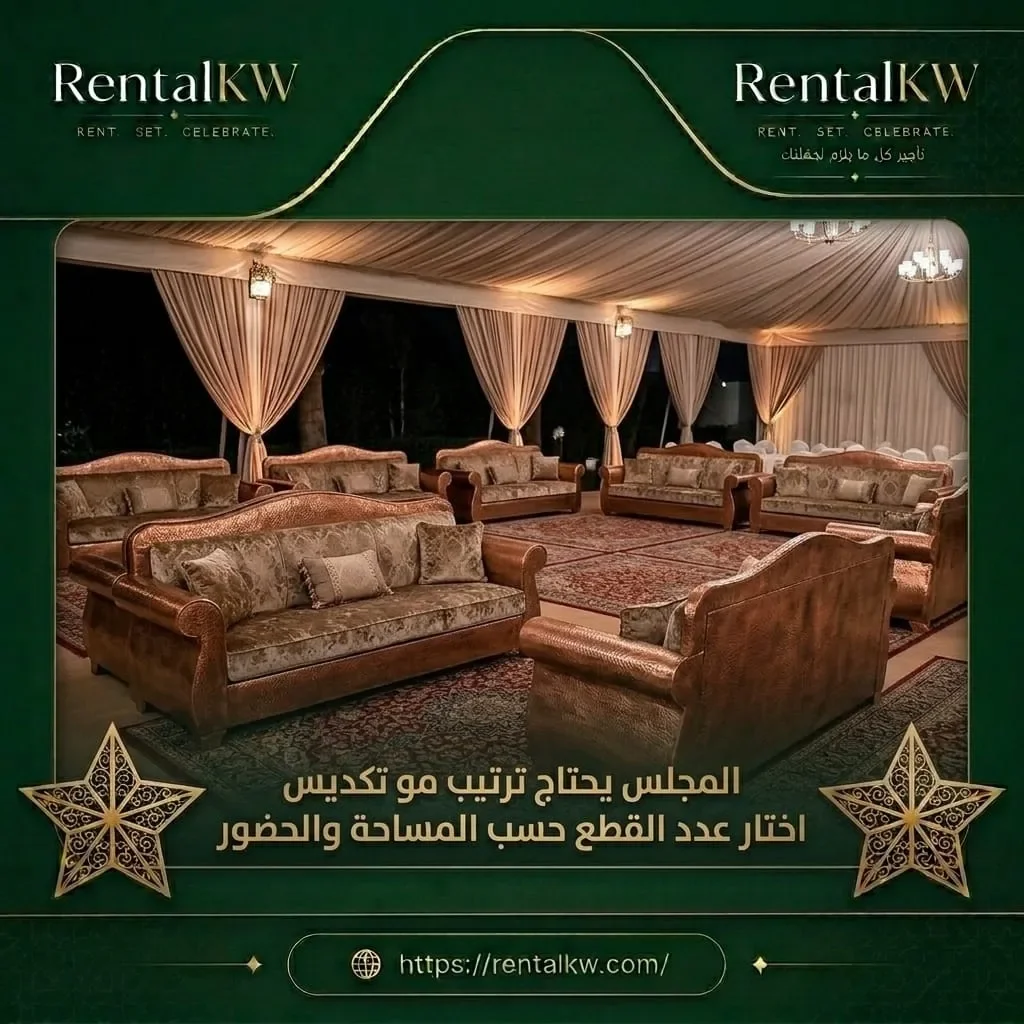
When considering Matrouq sofa rental based on majlis area, the total floor area alone does not provide an accurate answer. Part of the venue may be required for the entrance, hospitality service, guest circulation, or other elements, so the first step is to identify the portion of the space that can actually be converted into a practical seating area.
Matrouq sofas also use space differently from individual chairs. You do not calculate only the seating base. You must consider the full depth of the sofa, the space guests need in front of it, the area occupied by tables, and the circulation route. As a result, a majlis that appears spacious on paper may accommodate fewer guests than expected once all these elements are included.
The shape of the venue also matters. A rectangular majlis with long uninterrupted walls can use its available space differently from a venue containing columns or several openings. This is why converting square meters directly into a specific number of Matrouq sofa pieces is not a reliable calculation method.
A more accurate approach begins by defining the boundaries of the required seating area and identifying the depth occupied by the sofas and their related elements. The remaining central space can then be evaluated to determine whether it still allows comfortable movement or has become too restricted.
This is where taking measurements before booking becomes especially valuable. Adding one more sofa to a small space may provide little practical benefit if it blocks a walkway or forces the tables too close to seated guests.
When renting Matrouq sofas based on majlis area, it is better to:
• Separate the total majlis area from the usable seating area because entrances, hospitality routes, and fixed elements cannot realistically be counted as sofa space
• Record the shape of the room and the positions of columns, openings, and other elements that interrupt the seating line so the calculation reflects the space that can actually be used
• Calculate the depth of the sofas, tables, and the required space in front of seated guests as one complete unit instead of measuring only the sofa base and later discovering that the central area is too narrow
• Test additional sofa pieces on an approximate layout before confirming the quantity because the final sofa added to the room may reduce the quality of the majlis more than it increases seating capacity
• Prioritize ease of use whenever adding more seats conflicts with circulation space because an overcrowded majlis does not become better simply because it contains more sofas
• Measure the space again if the sofa model changes because differences in sofa dimensions can change the suitable quantity even when the majlis itself remains unchanged
Matrouq Sofas Based on Guest Count
Calculating Matrouq sofas based on guest count first requires distinguishing between the total number of people expected to attend and the number of guests who will actually need to sit on the sofas at the same time. This distinction prevents one of the most common mistakes when estimating the required quantity.
If an event receives one hundred guests over several hours, that does not automatically mean Matrouq sofa seating must be prepared for one hundred people. Guests may arrive and leave at different times, other types of seating may be available, and some visitors may use another area. On the other hand, if the event program requires most guests to be seated simultaneously, the required seating capacity will be considerably higher.
After determining the number of seats needed, the practical capacity of the selected sofa model must be established. It is better not to calculate this from sofa length alone because seat width, armrests, cushions, and the way the seating sections are divided all affect how many people can sit comfortably.
It is also useful to avoid calculating according to the maximum theoretical capacity. If a sofa can technically accommodate a certain number only when guests sit very closely together, that figure is not necessarily suitable for real use.
Guests can also be divided between different zones such as a main majlis, a family seating area, and a secondary diwaniya. This approach makes the distribution of Matrouq sofas more accurate than placing the entire guest count into a single calculation.
When choosing Matrouq sofas based on guest count, it is better to:
• Calculate the highest number of guests expected to require seats at the same time instead of using the total number of people who may attend throughout the entire event
• Exclude guests who will have access to other seating options from the Matrouq sofa calculation so the same person is not counted under more than one seating category
• Determine the practical capacity of the selected model by testing comfortable seating rather than dividing the sofa length by an assumed amount of space for each person
• Avoid using the tightest maximum seating capacity as the basis for booking because excessive crowding reduces comfort and makes the seating arrangement less practical
• Divide the required capacity between the main majlis and secondary seating areas when the event is spread across several zones instead of combining all guests into one calculation
• Check whether the venue can accommodate the resulting quantity after calculating the guest requirement because the theoretical number of seats must still match the actual available space
Setting Up a Majlis with Matrouq Sofas
Setting up a majlis with Matrouq sofas begins after achieving a balance between two factors: the number of people who need seats and the amount of space that allows those seats to be used comfortably. Relying on only one of these factors often produces an inaccurate result.
If planning begins only with the guest count, the final plan may require a quantity of sofas that the majlis cannot accommodate practically. If planning begins only with the available space, every wall may be filled with sofas even though the event does not need that much seating capacity. The two factors therefore need to be tested together.
A practical approach is to determine the target seating capacity first and then position the sofas in the most suitable seating areas. The number of seats created can then be compared with the actual requirement. If there is a shortage, the next step is not always to add another sofa. Depending on the event, another type of seating or a different distribution between zones may provide a better solution.
Space must also be reserved for elements that make the majlis usable such as coffee tables, entrances, and hospitality routes. These spaces are not wasted areas. They are essential parts of a functional setup.
A final practical test is important after the arrangement is complete. Several people can sit in different positions while entry, hospitality service, and movement from the seats are tested. This helps identify restrictions before guests arrive.
When setting up a majlis with Matrouq sofas, it is better to:
• Begin with a target seating capacity and test whether it can fit comfortably into the venue instead of filling the walls first and calculating the resulting number of seats afterward
• Position sofas first in the areas that are easiest to use before attempting to fill small or difficult spaces because adding pieces to unsuitable locations may create more problems than useful seating
• Preserve clear space for tables, hospitality service, and entrances as essential parts of the majlis rather than treating these areas as space that can be sacrificed to increase the sofa quantity
• Consider an alternative solution when the required capacity exceeds what the venue can comfortably support instead of continuing to squeeze additional sofa units into an already crowded majlis
• Test seating in several locations after the arrangement is completed to confirm that every seat shown on the layout can actually be reached and used comfortably
• Review the final seating capacity after tables and supporting elements are positioned because the true capacity of the majlis becomes clear only when the complete setup is in place
Calculating the Number of Matrouq Sofa Pieces
Calculating the number of Matrouq sofa pieces depends on the actual capacity of each model rather than a fixed number that can be applied to every seating arrangement. Sofa units differ in length, width, seat divisions, and the amount of space occupied by armrests, so two pieces with similar overall dimensions may provide different numbers of comfortable seats.
The first step is to determine how many seats must be provided on the sofas after excluding guests who will use chairs or other seating options. The practical capacity of the selected sofa can then be used to calculate an initial quantity. However, the calculation does not end there because the resulting number of pieces must still be tested against the dimensions of the majlis.
For example, the seating calculation may suggest that a certain number of units is required while the shape of the venue does not allow them to be arranged without blocking an entrance. In this situation, the solution is not to force the pieces into the available space. The seating distribution can be reconsidered, another model can be selected, or another area can be used.
It is also important not to confuse the number of pieces with the number of seats. Some setups use shorter units while others use longer sofas, so two rental offers should not be compared only by the number of individual pieces.
Any reserve quantity should also have a practical reason. Keeping a limited additional capacity may help when attendance changes, but ordering a large number of unnecessary pieces increases cost and consumes valuable setup space.
When calculating the number of Matrouq sofa pieces, it is better to:
• Determine the practical capacity of the model according to how many people can sit comfortably rather than relying only on the sofa length or external appearance
• Calculate the initial number of pieces after determining the required seating capacity and then test that quantity on the majlis layout before confirming the booking
• Compare rental offers according to total seating capacity, dimensions, and sofa type instead of comparing the number of pieces because unit sizes may vary between suppliers
• Recalculate the quantity whenever the sofa model changes even if the guest count remains the same because differences in length, depth, and capacity change the planning result
• Treat reserve pieces as a separate quantity with a clear purpose instead of automatically adding them to the main seating arrangement and creating unnecessary crowding
• Confirm the final quantity only after three factors are aligned together which are the required seating capacity, available space, and circulation routes needed for practical use
Matrouq Sofas for Large Diwaniyas
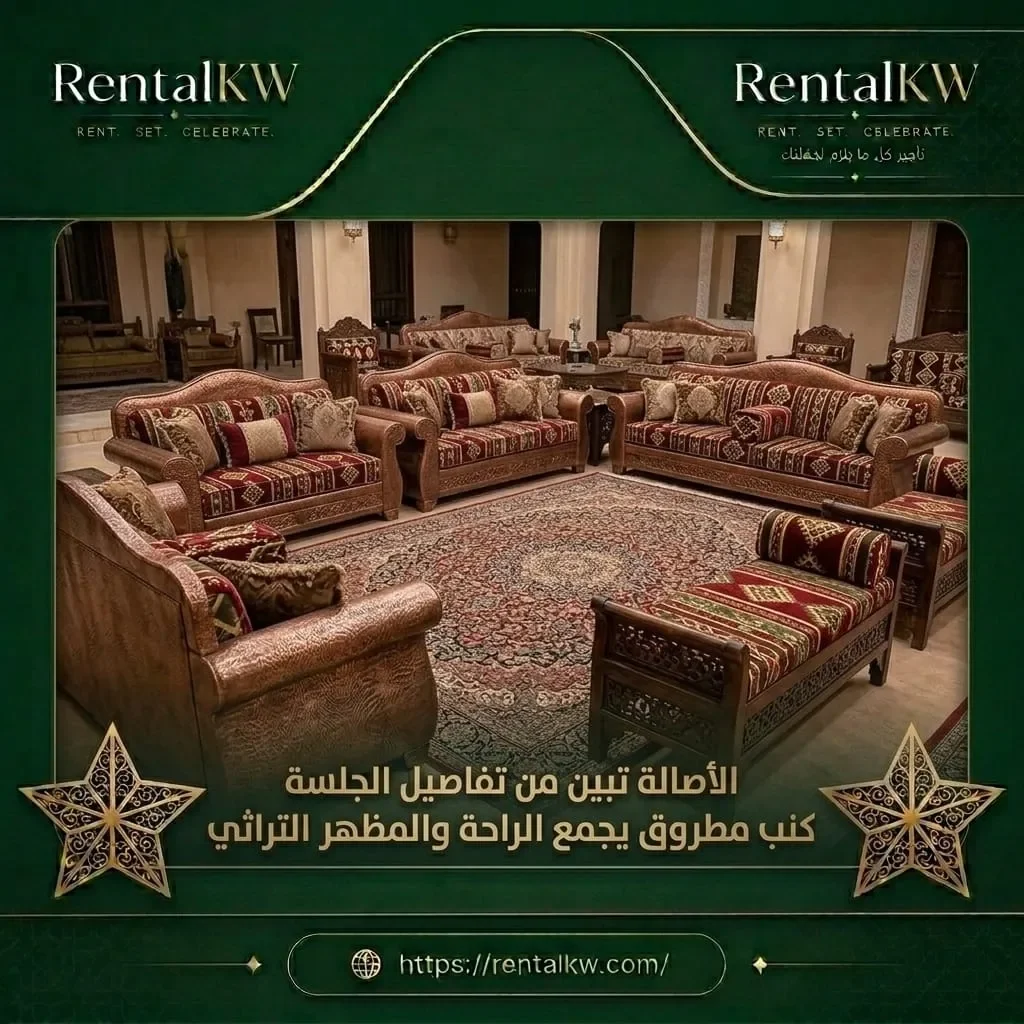
Matrouq sofas for large diwaniyas require a calculation method that treats the venue as several functional zones rather than one enormous empty area. A larger floor area does not mean the best solution is to create a continuous sofa line around every wall because long distances can leave some seats far from hospitality points or difficult for guests to reach.
A large diwaniya can be divided into a main seating zone and one or more secondary areas according to how the venue will be used. This approach makes quantity calculations more accurate and helps distribute guests naturally rather than concentrating most seats in one section.
Hospitality service routes must also be considered. As the majlis becomes larger, reaching all guests with coffee and refreshments becomes an important part of the seating plan. Several service points may be more practical than one location that is far from some seating areas.
A large diwaniya should also avoid turning unused floor area into a reason to order more sofas than necessary. Having additional space does not mean it must all be filled when the required seating capacity has already been achieved.
When choosing Matrouq sofas for large diwaniyas, it is better to:
• Divide the diwaniya into clearly defined use zones and calculate the seating capacity of each area separately instead of treating every wall as one continuous seating line
• Distribute the quantity according to where guests are actually expected to gather so one area does not become overloaded with seats while another contains sofas that receive little use
• Create suitable coffee and refreshment service points when distances are long so the size of the diwaniya does not create unnecessarily long hospitality routes
• Preserve circulation paths that connect the different seating areas because a large diwaniya requires more internal movement than a small majlis
• Avoid treating empty space as an automatic reason to add more sofas once the required capacity has already been provided comfortably
• Review the number of seats in every zone after distribution to make sure the combined capacity meets the requirement without increasing the quantity simply because the venue is large
Matrouq Seating for Small Majlis Spaces
With Matrouq seating for small majlis spaces, controlling the quantity becomes even more important because a single unnecessary sofa can change how the entire room functions. A small majlis does not allow sofas to be placed first while space for tables and movement is considered afterward.
A better starting point is to identify the elements that cannot be removed. These include a clear entrance, enough room in front of seated guests, and a suitable table or hospitality point. The remaining usable space can then be allocated to Matrouq sofas.
Choosing a sofa model that suits the size of the room may also be more effective than simply reducing the number of pieces. A deep sofa can consume valuable central space, while another model may provide the required seating capacity more efficiently.
Every seat also has greater value in a small majlis. This means excessive armrests, cushions, or decorative accessories that consume a large part of the seating surface should be avoided unless they serve a genuine purpose.
A small majlis should not be forced to accommodate more guests simply because the event requires additional capacity. If the required number exceeds what the room can support, an additional seating area or another appropriate solution is preferable to sacrificing circulation.
When preparing Matrouq seating for small majlis spaces, it is better to:
• Reserve the required circulation and table space first and then use the remaining area for sofas so essential walkways are not discovered only after the seating arrangement is complete
• Choose a model with dimensions and depth suited to the majlis instead of simply reducing the number of pieces from a sofa style that is fundamentally too large for the venue
• Use sofa units that provide good practical seating capacity without excessive armrests or accessories that reduce the number of usable seats in a limited area
• Avoid blocking corners and entrances with additional pieces just to increase the count because easy access to the majlis is more valuable than a seat that cannot be used comfortably
• Compare the required capacity with the realistic limits of the room early enough to consider another seating area if the guest count exceeds what the majlis can accommodate
• Preserve a reasonable amount of visual breathing space because a small majlis completely filled with furniture feels even smaller and becomes harder to use once guests arrive
Distributing Sofas Inside the Diwaniya
Distributing sofas inside the diwaniya affects real seating capacity just as much as the number of pieces. Two diwaniyas may contain exactly the same quantity of Matrouq sofas while one uses its seats much more effectively because entrances, tables, hospitality routes, and guest movement were planned before the final arrangement was confirmed.
Good distribution begins by identifying the circulation points that must remain free of furniture. The main seating areas can then be positioned in the most frequently used parts of the diwaniya before secondary seating zones are added.
The layout should also avoid creating isolated rows that make conversation difficult. A diwaniya is a social space, so seating directions should allow guests to see and communicate with one another comfortably without constantly changing their sitting position.
Tables should be distributed according to the number of people they actually serve. A table that can be reached comfortably by a suitable group of guests is more useful than increasing the number of tables until the space in front of the sofas becomes crowded.
When distributing sofas inside the diwaniya, it is better to:
• Mark entrances, circulation routes, and hospitality service points on the layout before placing the first sofa so the functional boundaries of the majlis are clear from the beginning
• Place the largest share of seating in areas expected to receive the most use instead of distributing pieces equally along the walls simply to achieve visual symmetry
• Orient seating in a way that supports natural conversation because good capacity has limited value if the arrangement makes communication uncomfortable
• Position tables according to how easily seated guests can reach them rather than using equal spacing that ignores the number of people in each area
• Avoid creating enclosed ends where seats become difficult to reach once the diwaniya is full so every seat included in the calculation remains practically usable
• Test the layout with several people in the room because actual circulation routes become much clearer once some of the seating is occupied
Matrouq Sofas Based on Majlis Length
Calculating Matrouq sofas based on majlis length differs from calculating by total floor area because the focus is on the wall lengths that can actually be converted into seating lines. This approach is particularly useful for long majlis spaces or diwaniyas where most of the seating follows the walls.
The entire wall length should not automatically be used. Doors, openings, and areas that must remain accessible need to be deducted first so the net usable length for sofas can be established.
That usable length can then be compared with the actual dimensions of the selected sofa units. A small section may remain that does not accommodate a full piece. In this situation, it is generally better to leave that section open than to force another sofa into the space simply to complete the wall.
Opposing seating lines must also be considered together. Adding sofas along both sides of a narrow majlis may create more seats but can reduce the central space needed for tables, hospitality service, and comfortable movement.
When choosing Matrouq sofas based on majlis length, it is better to:
• Measure every intended seating section separately and deduct doors, openings, and areas that must remain clear to establish the true usable seating length
• Compare the net usable lengths with the dimensions of the selected model instead of relying on an estimated number of pieces that is not connected to the actual size of each unit
• Leave a remaining section open if it cannot accommodate a full sofa comfortably instead of adding a piece that makes the end of the seating line narrow or impractical
• Check the distance between opposing seating lines after calculating their lengths because using both walls completely can significantly reduce the width of the central area
• Use length as a way to verify the quantity rather than as the only calculation factor because required capacity, sofa depth, and circulation still influence the final decision
• Recalculate if the orientation of the majlis or the location of the entrance changes because the usable seating length can change even when the room dimensions remain the same
Setting Up a Complete Arabic Majlis

Setting up a complete Arabic majlis does not mean increasing the number of decorative and functional elements. It means making the Matrouq sofas, tables, hospitality service, rugs, and circulation work together within one space without allowing one element to interfere with another. Matrouq sofas are often the foundation of the seating arrangement, so their quantity should be confirmed in a way that preserves enough room for all other functions.
After calculating the required number of seats, the tables that guests genuinely need can be positioned and the hospitality service route can be reviewed. Decorative elements can then be added according to the remaining space rather than being treated as a priority before practical use is considered.
Rugs can visually connect the majlis but should not interfere with furniture stability or guest movement. Armrests and cushions should also provide genuine comfort rather than consuming seats that were included in the capacity calculation.
A common mistake is to calculate the sofa capacity first and then place every additional element into the same remaining space. Final seating capacity should instead be evaluated after the complete majlis setup has been planned.
When setting up a complete Arabic majlis, it is better to:
• Confirm the number of essential seats first and then distribute supporting elements according to the remaining space so tables and decorations do not compete with the seating arrangement for the same area
• Determine the number of tables according to actual guest use instead of using them simply to fill the central area or create visual symmetry
• Make sure rugs and floor elements do not interfere with sofa stability or guest movement when entering and rising from the seating area
• Use armrests and cushions in quantities that improve comfort without turning a significant portion of the calculated seating capacity into unusable space
• Review the hospitality service route after the majlis is complete because an attractive setup loses part of its value if serving coffee becomes difficult once the seats are occupied
• Recalculate the final capacity after all elements have been added so the confirmed figure represents the number of seats that can actually be used in the completed majlis
Booking Matrouq Sofas Based on Quantity
Booking Matrouq sofas based on quantity requires more information than simply stating that an event will receive a certain number of guests. The number of people who will use the sofas simultaneously should be identified along with any other available seating options, the size of the majlis, and the required sofa model.
Once this information is available, an initial quantity can be calculated and tested against the venue. If the number of pieces does not fit the available space comfortably, it is better to modify the distribution or choose a different model instead of confirming a booking that will be difficult to implement.
The booking should also clearly define the sofa model, quantity, rental duration, delivery, arrangement, and collection according to the agreed service. These details affect the overall cost, so the price of one individual sofa is not enough to evaluate the complete offer.
If the guest count changes before the event, the rental provider should be informed rather than simply adding random pieces at the last minute. A significant increase may require reviewing the layout rather than only increasing the number of sofas.
When booking Matrouq sofas based on quantity, it is better to:
• Provide the number of people expected to use the sofas simultaneously while explaining what other seating options will be available so the same guests are not counted more than once
• Provide the majlis dimensions or usable seating lengths so the requested quantity can be checked against the space before the booking is confirmed
• Confirm the sofa model before finalizing the quantity because seating capacity and dimensions vary between models and can change the calculation
• Clarify the rental duration, required setup time, and the scope of delivery, arrangement, and collection so the service details and cost are understood before execution
• Review the layout again if the guest count increases significantly instead of adding extra units to leftover spaces without considering how they affect circulation
• Confirm the final quantity only after matching seating capacity with the available area and majlis length so the booking is based on three practical factors rather than a single estimate
Conclusion
Successful Matrouq sofa rental in quantities that suit the majlis size is not about reaching the largest possible number of pieces. It is about finding the quantity that provides the required seating capacity while preserving comfortable and practical use of the venue. The process begins by determining how many people are expected to need seats simultaneously and then establishing the practical capacity of the selected sofa model before comparing the result with the available area and usable seating lengths.
In large diwaniyas, dividing the venue into separate seating zones can produce a more practical arrangement. Small majlis spaces require greater protection of every area needed for circulation and hospitality service. The calculation should also be repeated whenever the sofa model, guest count, or majlis layout changes.
Using this method turns the final quantity into the result of practical measurement rather than guesswork. It also makes rental costs easier to evaluate because the requested quantity is connected to a genuine seating requirement instead of including unnecessary pieces that add expense without providing meaningful value to the majlis.
Frequently Asked Questions
How do I know how many Matrouq sofa pieces my majlis needs?
Determine how many people will need to sit on the sofas at the same time then identify the practical seating capacity of the selected model and compare the resulting quantity with the majlis area and usable seating lengths.
Is the majlis area alone enough to calculate the sofa quantity?
No. Doors, circulation routes, tables, hospitality service paths, and sofa depth all reduce the amount of floor space that can actually be used for seating.
Should I calculate Matrouq sofas based on the total guest count?
Not always. It is more accurate to calculate the number of people expected to need sofa seating simultaneously while considering chairs and any other seating areas available at the event.
Does a large diwaniya need sofas around every wall?
Not necessarily. Dividing a large diwaniya into several seating zones may be more practical and can prevent renting more sofas than the event genuinely requires.
What is the best solution for a small majlis with many guests?
It is better not to overcrowd the venue with sofas. Depending on the event and available space, an additional seating area or another suitable seating arrangement can be considered instead.
Does the required quantity change when the sofa model changes?
Yes. Sofa length, depth, and practical seating capacity vary between models, so the quantity should be recalculated whenever the selected model changes.
What affects the cost of Matrouq sofa rental?
The cost can vary according to the sofa model, quantity, rental duration, site conditions, and the agreed scope of delivery, arrangement, collection, and other included services.
When should the final Matrouq sofa quantity be confirmed?
It is better to confirm the final quantity after the guest requirement, sofa model, venue dimensions, and final layout are known so the booking reflects both seating capacity and available space.