
How Many Funeral Chairs Are Needed for Guests?
In this article
- How Many Funeral Chairs Do I Need?
- Number of Funeral Chairs Based on Attendance
- Funeral Chairs for 50 People
- Funeral Chairs for 100 People
- Funeral Chairs for 150 People
- Calculating the Number of Funeral Majlis Chairs
- Funeral Setup Based on the Number of Mourners
- Funeral Majlis Seating Distribution
- Funeral Majlis Space and Number of Chairs
- Booking Funeral Chairs by Quantity
- Conclusion
- Frequently Asked Questions
Determining the number of funeral chairs required does not begin with the question of how many people will visit the majlis throughout the entire day. A more accurate question is how many mourners are expected to be inside the majlis at the same time. This simple distinction completely changes the calculation and helps prevent booking more chairs than necessary or preparing too few seats and facing a shortage during peak attendance. From practical experience preparing funeral majlis gatherings, the most reliable estimate depends on three connected factors: peak attendance, the net seating area available, and the way rows and walkways will be arranged. A majlis may receive hundreds of mourners over several hours while requiring only a portion of that number in seats at any one moment. The correct calculation therefore combines realistic attendance figures with an understanding of how the majlis operates rather than simply assigning one chair to every expected visitor.
How Many Funeral Chairs Do I Need?
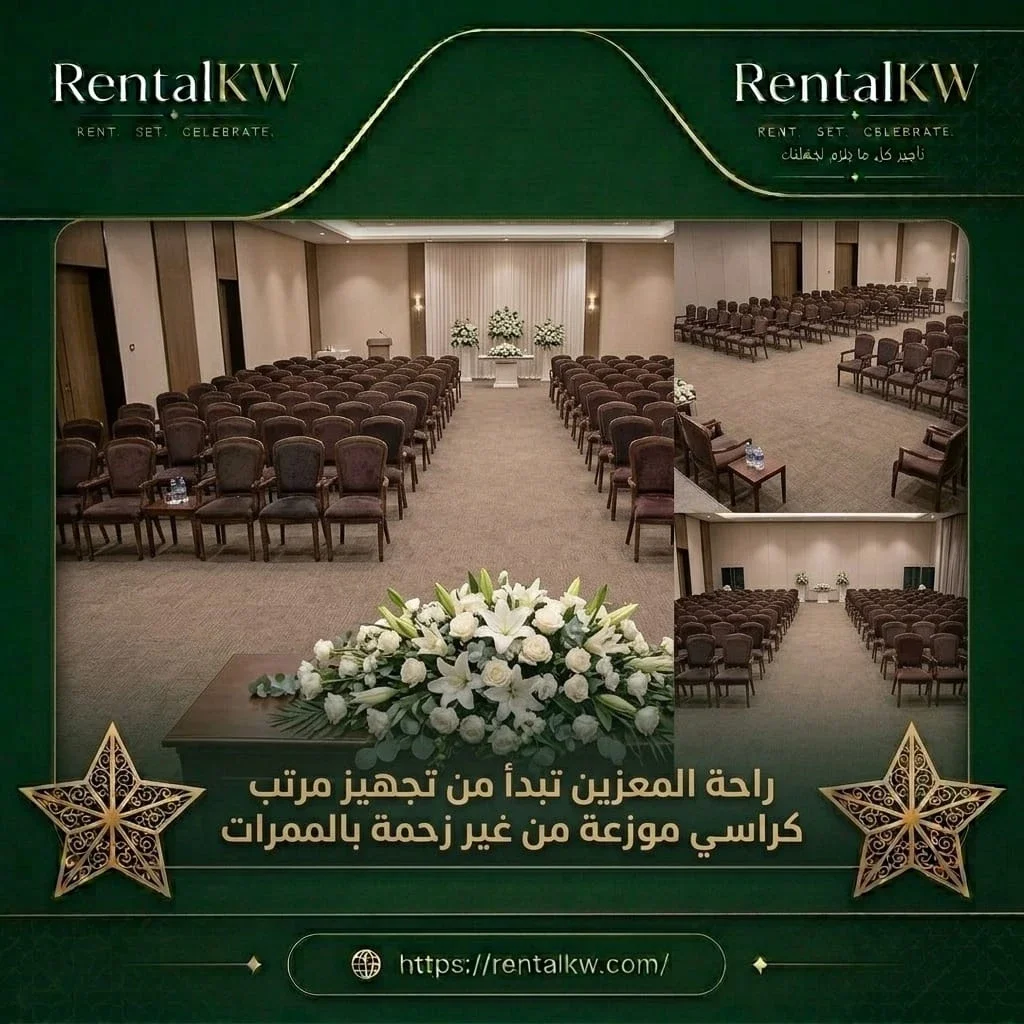
When asking how many funeral chairs do I need, the most accurate answer cannot be a fixed number because the appropriate quantity changes according to the pattern of guest arrivals, how long mourners remain seated, the size of the majlis, and the way the chairs are arranged. A common mistake is assuming that if 150 people are expected to attend the funeral gathering during the day, 150 chairs must be available inside the majlis at the same time. In reality, mourners may arrive and leave in different periods, which means the number actually present during peak attendance can be considerably lower than the total number of visitors.
From practical experience, the calculation can begin by estimating the highest number of people likely to be inside the majlis at one time and then adding a reasonable reserve instead of unnecessarily multiplying the quantity. If approximately 70 people are expected to be seated during the busiest period, for example, it may be practical to prepare a main seating quantity close to that figure while keeping a limited number of additional chairs nearby. These reserve chairs can be brought in quickly if attendance increases. This approach prevents the space from being filled with tightly packed rows throughout the entire day and avoids paying for a large quantity of chairs that may never actually be used.
However, the number of chairs alone is not enough. A venue may appear spacious when empty but its actual seating capacity decreases once walkways, tables, coffee service areas, and guest entrances are included. For this reason, the chair calculation should be based on the net area allocated specifically to seating rather than the total dimensions of the venue.
The nature of the majlis also affects the decision. A gathering where mourners arrive and leave frequently requires a flexible reserve seating plan, while a majlis where guests tend to remain for longer periods usually needs a larger number of chairs available from the beginning.
To calculate your actual requirements more accurately, consider:
• Estimating the highest number of mourners expected to be inside the majlis at the same time rather than the total number of people who may visit throughout the entire day
• Keeping a reasonable reserve quantity that can be added when attendance increases instead of filling the available area with unused chairs from the beginning
• Calculating the seating area only after excluding entrances exits walkways hospitality areas tables and any other equipment located inside the majlis
• Considering how long mourners are likely to remain because a majlis with rapid seat turnover requires a different arrangement from one where guests remain seated for extended periods
• Avoiding compressed rows simply to increase capacity because an additional chair provides little practical value if it blocks a walkway or makes seats difficult to reach
• Reviewing the required quantity again before execution if attendance expectations or venue dimensions change instead of relying on a number calculated before the actual conditions were known
Number of Funeral Chairs Based on Attendance
The number of funeral chairs based on attendance should be determined according to simultaneous attendance rather than the total number of people registered or expected to visit during the full condolence period. This is particularly important because some majlis gatherings may receive 300 or 400 mourners over several hours without having all of those people present at the same time. Calculating one chair for every person expected throughout the day can therefore result in a substantial excess of chairs, unnecessary space requirements, and additional costs that could have been avoided.
From a practical perspective, attendance estimates can be divided into three general situations. If mourners are expected to arrive gradually over a long period, it may be sufficient to prepare a percentage of the total expected attendance while keeping additional chairs available as a reserve. If most mourners are expected to arrive during a specific period, such as after a prayer or during a known evening peak, the main seating quantity should be increased because the concentration of attendance will be much higher. When attendance patterns are difficult to predict, a flexible layout that allows extra rows to be introduced quickly is usually more practical.
For example, if 200 people are expected to visit the majlis over several hours but experience or the nature of the gathering suggests that only around 80 to 100 people are likely to be present at the same time, arranging 200 chairs inside the majlis may be impractical. A better approach would be to prepare enough seating for the expected peak and maintain a suitable reserve that provides flexibility if the actual attendance becomes higher.
It is also important to remember that every additional chair requires more than the physical area occupied by the chair itself. Extra seating also requires sufficient circulation space and practical access. The real capacity of the majlis therefore decreases when rows are arranged in a way that allows mourners to move comfortably.
To estimate the number of chairs according to attendance more accurately:
• Separate the total expected number of visitors from the number likely to be present during peak attendance because the second figure determines the main seating requirement
• Consider the expected timing of arrivals because one concentrated busy period may require significantly more chairs than a majlis receiving the same total number of visitors gradually over several hours
• Maintain a reasonable reserve quantity that can be introduced if attendance exceeds expectations without allowing unused reserve chairs to occupy the main seating area from the beginning
• Match the number of chairs to the actual usable area so the numerical estimate does not exceed what the majlis can accommodate comfortably
• Consider elderly mourners and other guests who are more likely to require guaranteed seating because the characteristics of the attendees can increase seating requirements even when some visitors remain only briefly
• Avoid automatically copying quantities used for a previous gathering because differences in venue size attendance timing and guest behavior can significantly change the actual requirement
Funeral Chairs for 50 People
When preparing funeral chairs for 50 people, the first step is determining whether the figure of 50 represents the number of people expected to be inside the majlis simultaneously or the total number of visitors expected throughout the condolence period. If the intention is to seat 50 people at the same time, the requirement is not simply to place 50 chairs inside the venue. The space must accommodate those chairs together with walkways, entry and exit movement, and possibly a limited reserve quantity for unexpected increases in attendance.
From practical setup experience, a majlis designed for approximately 50 mourners can often be organized more comfortably when the seats are divided into several groups rather than arranged in long continuous rows. This makes the inner chairs easier to reach and prevents a person seated near the end of a row from requiring many other mourners to move whenever someone enters or leaves.
If 50 represents the total number of visitors expected over several hours rather than simultaneous attendance, there may be no need to prepare all 50 chairs. A smaller number can be arranged according to expected peak occupancy while additional chairs are kept nearby as a reserve. This approach provides more room for hospitality service and movement and makes the majlis feel less visually crowded.
A relatively small number of guests does not mean planning can be ignored. In a limited space, even one table positioned incorrectly may prevent an additional seating row from being installed or may narrow an important walkway. It is therefore better to establish the seating layout before furniture is brought into the area.
When planning a majlis for approximately 50 people, review:
• Whether the figure of 50 represents simultaneous attendance or the total number of visitors because this distinction alone can significantly change the required number of chairs
• Dividing chairs into shorter seating groups that make entry and exit easier instead of creating one long row that is difficult to access at the far end
• Keeping a limited reserve quantity outside the main arrangement instead of adding unnecessary rows to the seating area without confirmed demand
• Leaving a clear transition area at the entrance so the first chair does not begin directly within the route used to receive mourners
• Determining the locations of coffee and water tables before fixing the seating rows so essential walkways are not consumed after the chairs have already been arranged
• Testing movement through the majlis after the chairs are physically positioned because a layout may appear suitable on paper while actual use reveals that some distances need adjustment
Funeral Chairs for 100 People
When preparing funeral chairs for 100 people, organizing the available space becomes significantly more important because the difference between a successful layout and an overcrowded one may depend on how the one hundred chairs are divided rather than on the size of the majlis alone. If the requirement is to seat one hundred mourners at the same time, the calculation should include not only the seating area but also walkways, entrance and exit zones, hospitality space, and any tables or fixed equipment inside the venue. If the figure of one hundred represents the total number of visitors expected over several hours, however, the actual number of chairs required may be lower depending on how frequently seats become available as mourners arrive and leave.
From practical setup experience, it is generally better not to arrange one hundred chairs as a single block even when the space technically allows it. Dividing the seats into sections makes entry and exit easier and helps manage the majlis when certain areas fill faster than others. It also allows an additional seating section to be opened or kept unused according to attendance levels instead of distributing every chair from the beginning.
In a majlis of this size, reserve chairs become more important, but they need a clearly designated location. Placing dozens of additional chairs along the sides of walkways creates another problem instead of solving a potential shortage. A better approach is to keep reserve seating outside the main arrangement or in an area that is not used for circulation so chairs can still be moved quickly when required.
Peak attendance timing should also be considered. If a large number of mourners are expected to arrive within a short period, it is better to prepare the required seating capacity before that period rather than trying to add chairs while guests are entering.
When preparing a majlis for approximately one hundred people, consider:
• Determining whether the figure of one hundred represents the expected number of people seated at the same time or the total number who will visit the majlis because each situation requires a completely different calculation
• Dividing the seating into clearly defined sections so mourners can reach inner chairs without passing in front of a large number of seated guests
• Designating a separate location for reserve chairs so they remain ready for use without narrowing walkways or affecting the organized appearance of the majlis
• Calculating the space required for hospitality coffee and water tables before approving the final number of seats because these elements reduce the net seating area
• Preparing the appropriate seating quantity before the expected peak period so new rows do not need to be added while a large group of mourners is arriving
• Maintaining clear exits and circulation routes even when the majlis could theoretically accommodate a larger number of chairs
Funeral Chairs for 150 People
Preparing funeral chairs for 150 people requires more detailed planning because increasing the capacity does not simply mean adding fifty chairs to a majlis designed for one hundred people. Every additional group of chairs requires walkways, access space, and an arrangement that supports the movement of mourners. A majlis that comfortably accommodates one hundred chairs may therefore be unable to accommodate one hundred and fifty with the same level of comfort simply because some unused space remains around the edges.
From a practical perspective, it is better to divide this quantity into several seating sections instead of creating excessively long rows. Each section can have access to a nearby entrance or walkway that helps distribute movement. This becomes particularly important when a busy period ends and a large group of mourners leaves while another group is arriving at the same time.
A majlis of this size also requires hospitality service to be considered alongside the seating plan. If coffee or water service is located at only one end of the venue, hospitality staff may need to travel long distances between rows repeatedly. The chair layout should therefore consider staff circulation just as carefully as the movement of mourners.
One mistake that commonly appears when trying to accommodate 150 people is reducing the distance between chairs excessively in order to reach the required number. It is usually better to reduce the actual seating quantity or provide additional space when available rather than turning the majlis into tightly compressed rows that are difficult to enter and leave.
When planning one hundred and fifty chairs, review:
• The actual ability of the site to accommodate the quantity after calculating all walkways and service areas rather than relying only on the total floor area
• Dividing the seats into several sections so the movement of one hundred and fifty people does not depend on a single walkway or internal access route
• Providing circulation routes that allow one group to leave while another enters during periods of high guest turnover
• Connecting the seating arrangement with hospitality locations so service staff do not need to cross the entire majlis during every serving round
• Avoiding reductions in spacing between rows simply to achieve a specific number if doing so would make seating and movement uncomfortable
• Preparing an alternative plan if attendance exceeds expectations such as additional usable space or organized reserve seating rather than placing random chairs inside walkways
Calculating the Number of Funeral Majlis Chairs
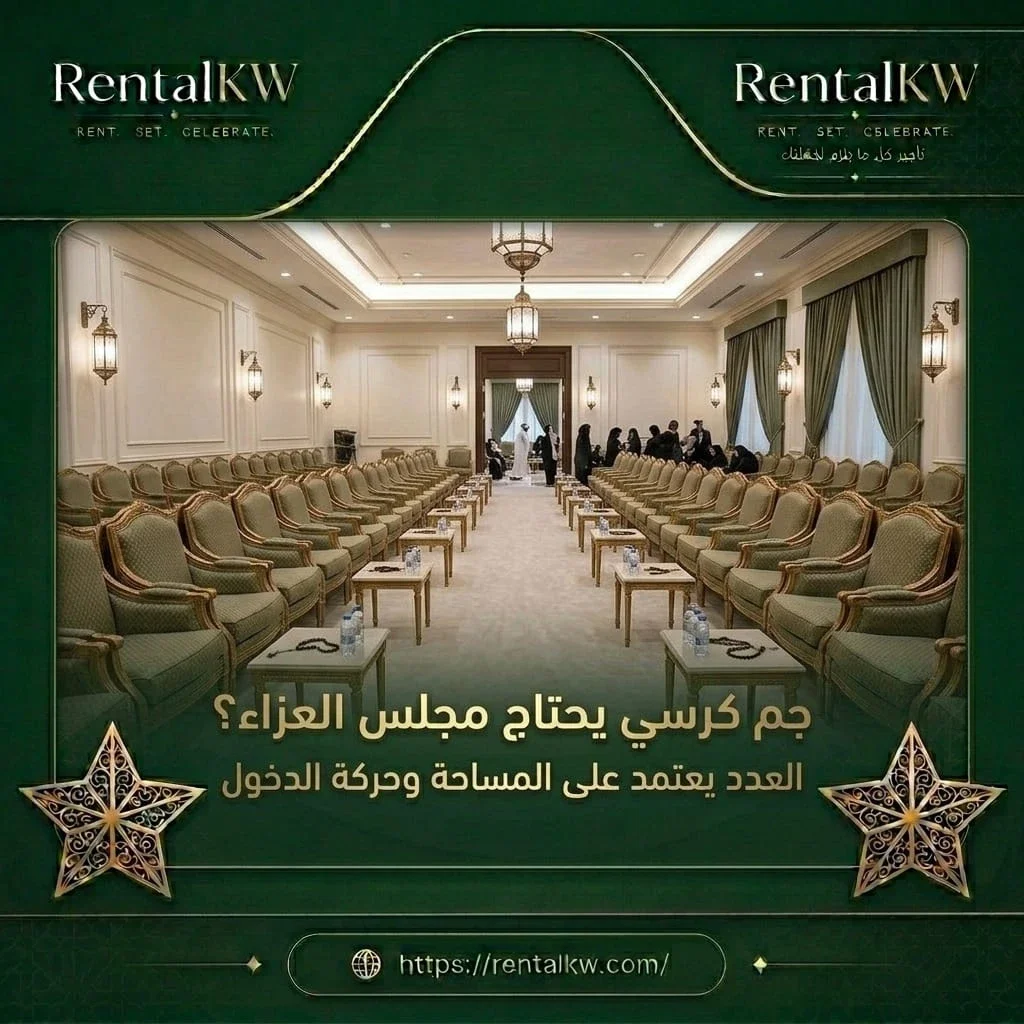
Calculating the number of funeral majlis chairs requires combining attendance estimates, venue measurements, and an understanding of how the majlis will actually operate. Relying on only one factor can produce an unrealistic figure. Knowing the dimensions of the location without knowing the expected number of mourners is not enough, just as knowing the attendance estimate without measuring the available area may result in an order that the venue cannot accommodate.
A practical calculation begins by identifying expected peak attendance and then measuring the portion of the venue that will actually be used for seating. Walkways, reception areas, hospitality zones, and any other equipment should then be defined before calculating how many chairs can be arranged comfortably.
The resulting number should be treated as a practical operating capacity rather than a target that must be exceeded. If the comfortable arrangement supports a certain number of seats, additional rows should not be placed in walkways simply to achieve a higher figure.
Two levels can also be used in the calculation: a main quantity that is ready from the beginning and a reserve quantity that is introduced only when required. This approach provides greater flexibility, particularly when attendance levels are difficult to predict accurately.
To calculate the quantity practically:
• Determine expected peak attendance instead of relying on the total number of mourners throughout the entire period
• Measure the net seating area after deducting all other uses of the space
• Establish walkway locations before calculating the final number of seating rows
• Define a main seating quantity and a separate reserve quantity
• Check how easily the final chair in every row can be reached
• Recalculate the requirement if the venue dimensions or majlis layout change before the gathering
Funeral Setup Based on the Number of Mourners
Funeral setup based on the number of mourners means converting the expected attendance figure into an operating plan for the entire majlis rather than using it only to determine the number of chairs. The number of mourners also influences the size of the reception area, the number of circulation routes, the hospitality space required, and the way seating should be divided.
When attendance is limited, it may be better to group chairs within a balanced seating area rather than spreading them across a large majlis and leaving excessive gaps. With larger attendance figures, dividing the majlis into separate sections becomes more important so one area does not turn into a congestion point.
From a practical perspective, changes in attendance throughout the condolence period should also be considered. The majlis may begin quietly and then experience a significant increase in visitors during a particular period. A flexible setup is therefore more effective than a fixed arrangement that is difficult to modify.
When matching the setup to the number of mourners, consider:
• Identifying the periods of highest attendance instead of relying only on the total daily figure
• Choosing the main seating quantity according to the busiest expected period
• Expanding or reducing the active seating area according to actual use
• Maintaining reserve space that can be activated when needed
• Adjusting hospitality points according to the density of the majlis
• Reviewing the furniture arrangement if attendance expectations change before execution
Funeral Majlis Seating Distribution
Funeral majlis seating distribution determines how effectively the available number of chairs can actually be used because one hundred properly arranged chairs may serve the gathering better than a larger number distributed in a way that obstructs movement. The objective is not to achieve the highest possible seating density but to provide easy access to chairs while maintaining clear and understandable walkways.
From practical experience, rows that are long and accessible from only one side should generally be avoided. Providing more than one access point reduces disruption to seated mourners when someone needs to leave.
The shape of the venue can also be used to determine the direction of different seating sections instead of forcing the same grid arrangement into every location. Long spaces require a different approach from square majlis areas or sites containing columns and side entrances.
When distributing seats, consider:
• Keeping each row at a practical length that supports easy entry and exit
• Creating walkways that serve multiple seating sections without producing confusing intersections
• Working with the shape of the venue instead of forcing an impractical arrangement into it
• Keeping chairs near exits easy to access
• Preventing reserve chairs from being added inside established walkways
• Reviewing the seating distribution after part of the majlis becomes occupied rather than judging it only while the venue is empty
Funeral Majlis Space and Number of Chairs
Funeral majlis space and number of chairs are directly connected, but there is no single fixed equation because the area required for a functional majlis includes much more than the physical space occupied by chairs. A wide entrance, tables, columns, or a hospitality area can reduce the number of chairs that can be arranged even when the total venue area appears large.
For this reason, the most useful measurement is the net space available after excluding areas that cannot be used for seating. Different seating layouts can then be tested to find the best balance between capacity and comfort.
The shape of the venue can also be more important than its total area. A long and narrow location may require different walkways from a square location with the same overall floor area, which means the practical seating capacity can also differ.
When connecting the available space with the number of chairs:
• Measure the area that can actually be used rather than relying only on the external dimensions of the venue
• Exclude hospitality areas entrances and physical obstacles from the seating calculation
• Consider the shape of the location when determining the direction of seating rows
• Avoid using every available meter for chairs at the expense of circulation
• Test a realistic seating arrangement before approving the final quantity
• Choose a lower number if the larger quantity would create narrow and impractical walkways
Booking Funeral Chairs by Quantity
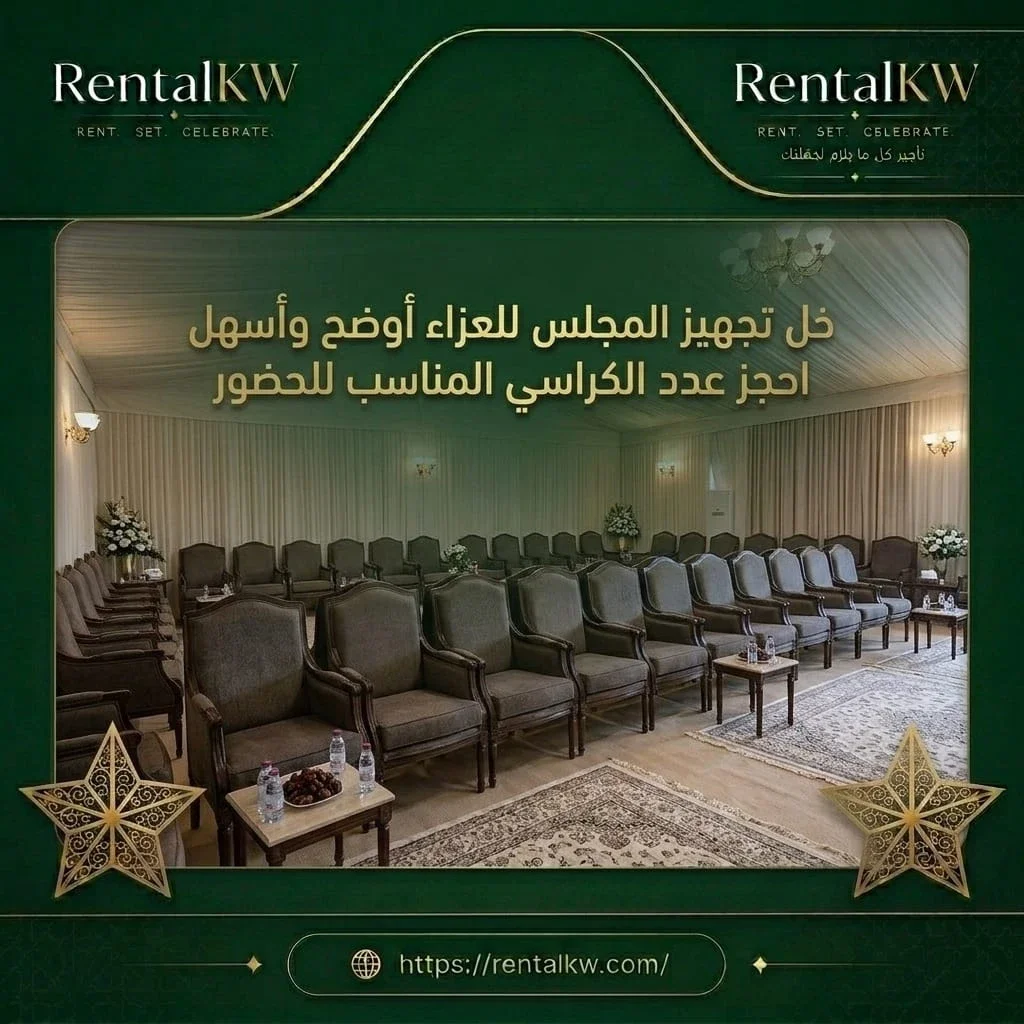
Booking funeral chairs by quantity helps control both cost and setup requirements when the reservation is based on a realistic estimate rather than ordering a large quantity simply as a precaution. A better approach is to determine a clear main quantity and then confirm whether additional chairs can be supplied if needed when the service conditions allow.
From a practical perspective, the price per chair should not be the only factor considered when comparing offers. The final cost may vary according to quantity, rental duration, transportation, arrangement, and collection. The complete service should therefore be compared so that one quotation does not appear cheaper simply because additional charges were excluded from the initial price.
The quantity should also be confirmed with sufficient time before delivery and updated if attendance expectations change. Booking early is important, but it does not mean ignoring new information that becomes available before the majlis date.
When booking according to quantity, confirm:
• Determining the main quantity according to expected peak attendance
• Knowing how many reserve chairs can be made available if required
• Clarifying the cost of any increase beyond the agreed quantity
• Confirming whether transportation arrangement and collection are included in the price
• Confirming the final quantity before the scheduled delivery time
• Avoiding payment for a large quantity simply as a precaution when a more flexible solution can handle potential increases
Conclusion
The answer to how many funeral chairs are needed based on attendance cannot be obtained from one formula that applies to every majlis. The correct quantity depends on peak attendance, the net seating area, how long mourners remain, and the way chairs are distributed throughout the venue.
A single majlis may receive hundreds of people during the day without requiring the same number of chairs at one time. Distinguishing between total visitors and simultaneous attendance therefore prevents unnecessary overbooking and helps use the available space more efficiently.
With attendance levels such as 50, 100, or 150 people, seating distribution becomes an essential part of the calculation. Increasing the number of chairs also increases the need for walkways, access routes, and service space, which means the physical area occupied by each chair cannot be considered in isolation.
Keeping an organized reserve quantity is also more practical than filling the majlis with chairs from the beginning. Reserve chairs should remain nearby and easy to introduce when required, but they should not occupy walkways or compress the main seating arrangement.
Ultimately, the best plan is one that provides enough chairs while keeping the majlis comfortable and easy to move through. The largest possible number is not always the best choice. The correct number is the one that genuinely matches attendance, available space, and the way the majlis will be used.
Frequently Asked Questions
Do I need one chair for every person expected at the funeral?
Not necessarily if the attendance figure represents the total number of visitors expected over several hours. It is more practical to calculate the highest number of mourners likely to be inside the majlis at one time and then provide a suitable reserve according to the expected attendance pattern.
How many reserve funeral chairs should be provided?
There is no fixed percentage that works for every majlis because the requirement depends on how accurately attendance can be estimated, how easily additional chairs can be supplied, and how much storage space is available. The important point is to keep a reasonable reserve without creating congestion inside the majlis.
Are 50 chairs enough if 50 people are expected?
If all 50 people are expected to be seated at the same time, the full quantity should be available and the venue must be able to accommodate it comfortably. If the figure represents the total number of visitors arriving at different times over several hours, the actual seating requirement may be lower.
How do I prepare a majlis for 100 people?
Start by determining whether the figure represents simultaneous attendance. Then divide the seating into sections, maintain clear walkways, and determine hospitality locations before approving the final quantity while keeping organized reserve seating available if required.
What do I need when preparing 150 funeral chairs?
You need enough space for the chairs, walkways, and service areas while dividing the seating into manageable sections. Excessively long rows and compressed seating should be avoided simply to achieve the required number.
Does the size of the majlis alone determine the number of chairs?
No. The shape of the venue, entrances, tables, columns, and hospitality areas all affect the actual seating capacity. The net area that can genuinely be used for seating should therefore be calculated.
Is it better to book a large number of additional chairs?
Not always. It is usually more practical to provide a main quantity that matches expected peak attendance together with a reasonable reserve that can be added when needed instead of paying for a large quantity and consuming valuable majlis space from the beginning.
What is the most important information before booking funeral chairs?
The most important information is the highest number of mourners expected to be present at the same time. This figure should then be compared with the actual seating area available after accounting for walkways and service zones.