Tent AC Rental for Summer Events
In this article
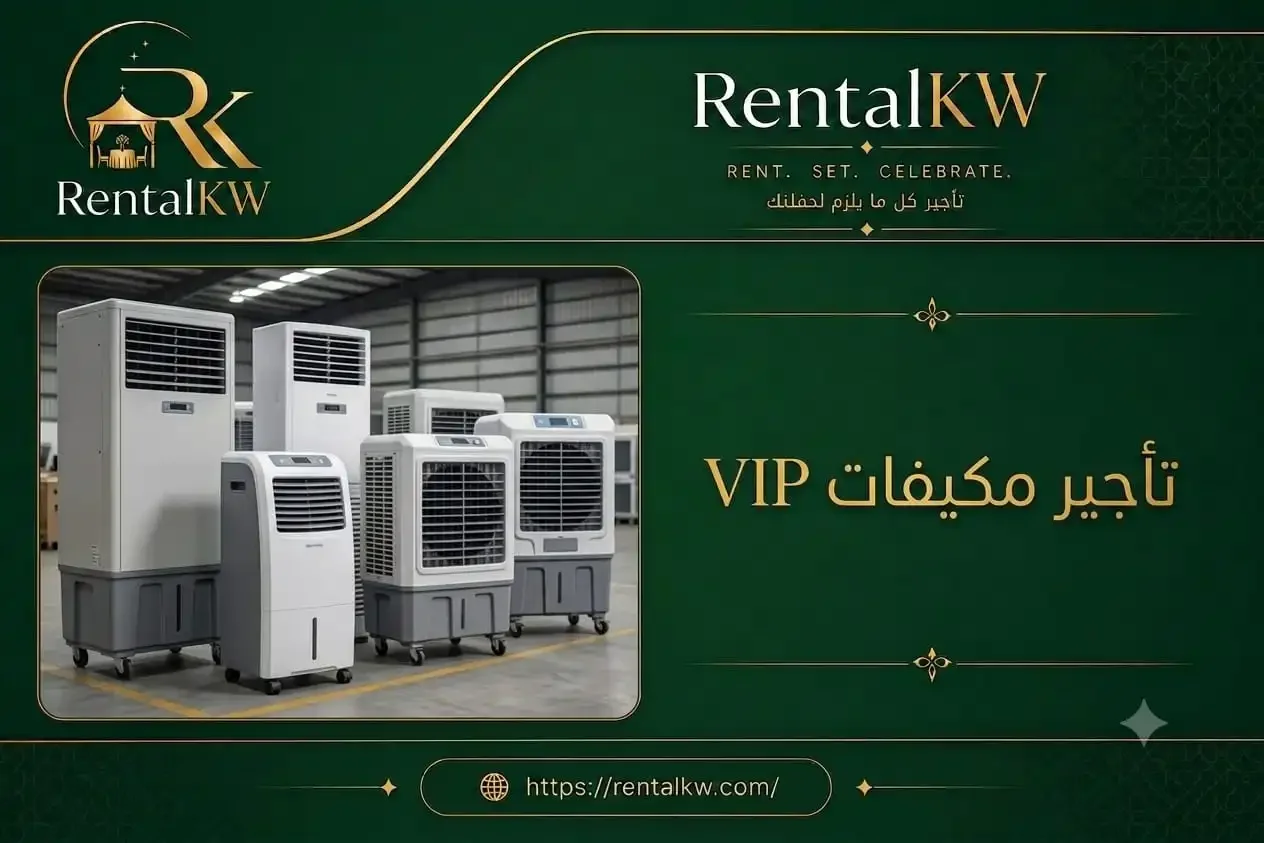
- Tent AC Rental in Kuwait
- Evaporative Coolers for Tents
- Floor-Standing Air Conditioners for Events
- Split Refrigerant AC Rental for Tents
- Cooling Wedding Tents
- Air Conditioners for Summer Events
- Air Conditioning Large Tents in Kuwait
- Cooling Units for Outdoor Events
- Installing Air Conditioners Inside Tents
- Booking Tent Air Conditioners in Kuwait
- Conclusion
- Frequently Asked Questions
Cooling a tent in summer is not simply a matter of placing one or two air conditioners inside and switching them on before guests arrive. A tent is affected by direct sunlight, the number of attendees, lighting, electrical equipment, frequently opened entrances, and the type of fabric or lining used to cover the structure. All of these factors increase the heat load inside the venue. From practical event setup experience, one of the most noticeable mistakes is choosing air conditioners based only on tent size and then discovering that cool air does not reach every seating area or that the units run continuously without achieving the required comfort level. Proper cooling therefore starts with understanding the tent itself, followed by selecting the right AC type and capacity, checking the available power supply, and planning airflow distribution before confirming the number of units and installation method.
Tent AC Rental in Kuwait
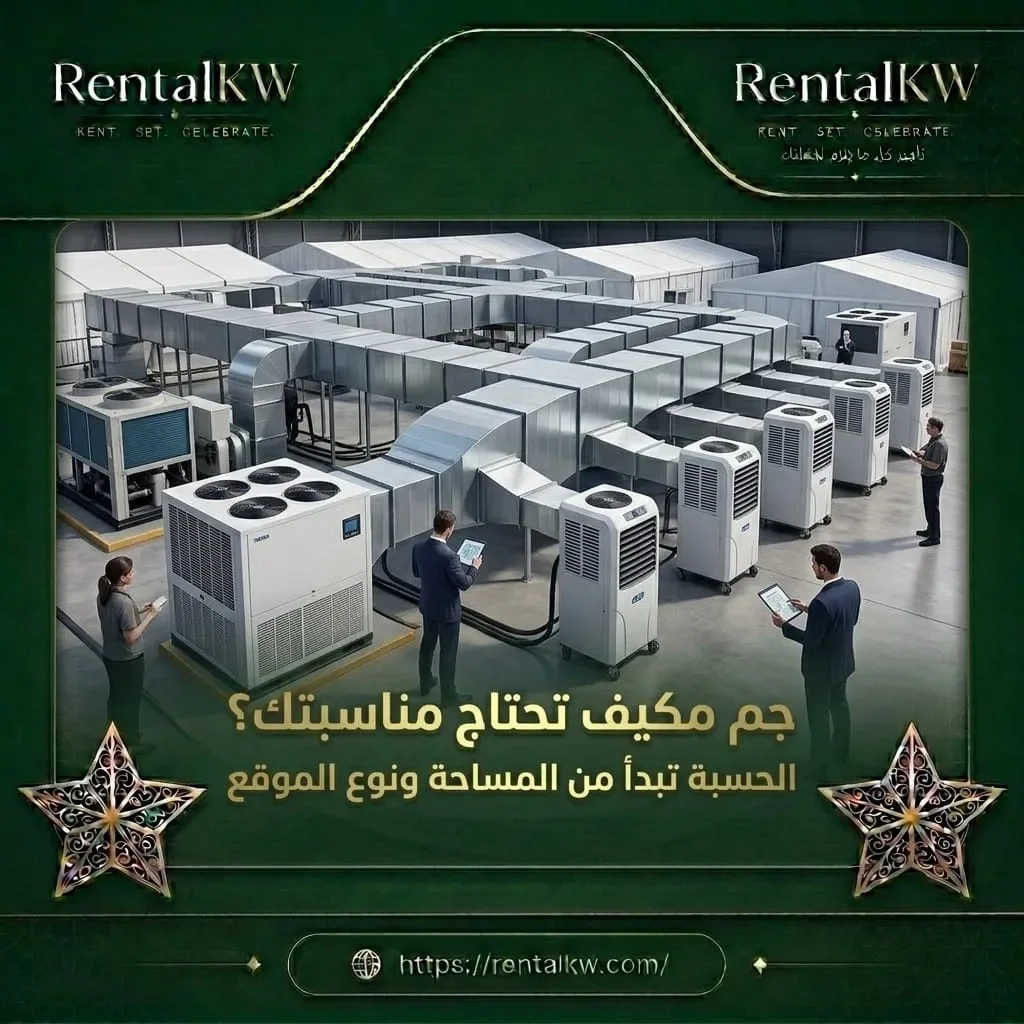
When considering tent AC rental in Kuwait, the service should be treated as a complete cooling system rather than simply renting a certain number of air-conditioning units. Summer temperatures inside tents can rise quickly, particularly when an event takes place during the daytime, starts before sunset, or the tent is exposed to direct sunlight from several directions. Choosing the right AC type and number of units therefore requires understanding the actual site conditions before confirming a final quantity.
The first practical factor is tent size, but floor area alone is not enough. Ceiling height, the type of tent lining, whether an additional insulation or roof layer is installed, the amount of glazing or openings, and the way entrances are used can all affect how much heat enters the venue. Two tents with identical floor areas may require completely different cooling setups if one is well enclosed and shaded while the other receives direct sunlight and has a main entrance that remains open for much of the event.
Guest count is another important factor because every person adds heat to the tent. Strong lighting, display screens, sound equipment, and certain food-service appliances can also increase the internal temperature. For this reason, selecting air-conditioning equipment based only on floor area while ignoring what will happen inside the tent during the event is not a reliable professional approach.
Practical event setup also shows the importance of having a contingency plan. For a large event, the cooling system should not be switched on for the first time only a few minutes before guests arrive. The electrical supply should be checked, the units should be operated early, and comfort should be reviewed in several parts of the tent. A cooling or electrical problem discovered before the event is much easier to correct than one that appears after the tent is full.
The price is usually influenced by the type of air conditioner, cooling capacity, number of units, rental duration, delivery location, installation requirements, electrical supply, and any additional accessories. Quotations should therefore be compared according to the complete cooling setup rather than the rental price of an individual unit.
Before booking tent air conditioners, it is useful to:
• Provide the internal tent dimensions height and event time so the effect of space and daytime heat can be evaluated instead of choosing capacity based on floor area alone
• Explain the expected number of guests together with the lighting and equipment inside the tent because these elements create additional heat that should be included in the cooling calculation
• Confirm the proposed AC type and capacity of every unit together with the method used to reject hot air or position the outdoor unit instead of looking only at the number of machines
• Review the available electrical supply and load capacity before installation so the selected number of air conditioners does not exceed what the site can operate reliably
• Arrange delivery installation and testing early enough before the event to identify weak cooling or electrical problems and make the necessary adjustments
• Compare the final price according to transportation installation operation dismantling rental duration and any additional extensions instead of comparing the standalone rental cost of each unit
Evaporative Coolers for Tents
Choosing evaporative coolers for tents requires understanding how they operate before treating them as a direct alternative to refrigerant-based air conditioning. An evaporative cooler works by evaporative cooling, which means its effectiveness is connected to air temperature, humidity, and adequate air exchange. It may provide good results under certain conditions while becoming less effective in humid weather or inside a completely enclosed tent where moisture-laden air cannot escape properly.
A common mistake is operating several evaporative coolers inside a tightly enclosed tent and expecting the temperature to continue dropping in the same way it would with refrigerant-based air conditioning. This type of cooling generally needs suitable airflow because its operating principle adds moisture to the air. If the same air remains trapped and continues circulating, humidity may rise and the improvement in comfort can gradually decrease.
Evaporative coolers can therefore be more appropriate for certain open or semi-open tents and venues that benefit from continuous airflow. However, the decision should still depend on actual weather conditions and the nature of the event. A formal celebration that requires more stable temperature control may have different needs from an open outdoor gathering where the main objective is simply to reduce the sensation of heat.
Air direction is equally important. An evaporative cooler should not simply be positioned in a distant corner with the expectation that it will cool an entire large tent. The airflow path should be studied, and large obstacles that prevent cooled air from reaching the main seating areas should be avoided.
From a cost perspective, this option may appear economical in certain situations, but it is not automatically the best choice simply because the rental rate is lower. The real value depends on whether the system suits the venue and can provide the required comfort under the actual event conditions.
When considering evaporative cooling, it is important to:
• Evaluate humidity and the nature of the location before choosing this system because evaporative cooling does not provide the same performance under all weather conditions
• Ensure that there is an appropriate route for air to enter and leave rather than operating the units inside a tightly enclosed tent as if they were conventional refrigerant air conditioners
• Determine the airflow direction and connect it with the actual seating zones so most of the cooled air is not wasted in walkways or areas without guests
• Check the water tank capacity or the method used to supply water to the equipment together with a monitoring plan if the event will continue for several hours
• Avoid choosing evaporative cooling only because the rental price is lower when the event requires more stable control of temperature and humidity
• Test the system inside the actual tent before the event and assess temperature and humidity in the seating areas instead of judging performance only by how strong or cool the air feels directly at the outlet
Floor-Standing Air Conditioners for Events
Floor-standing air conditioners for events can be a practical option for certain tents and temporary venues because they occupy relatively limited floor space and can be distributed close to the areas being used. Their effectiveness, however, depends on choosing the right capacity and correctly managing heat rejection, drainage, and electricity rather than simply positioning the unit inside the tent and switching it on.
The first point to understand is the specific type of floor-standing unit. Some are refrigerant-based systems that require an outdoor component or a proper route for rejecting heat, while other models operate differently. If the heat produced by the refrigeration cycle is not transferred outside the tent, the system will not achieve the required result regardless of how cool the air initially feels at the outlet.
Distribution also requires avoiding the placement of all units along one side. In a long tent, this can create a very cold zone near the equipment while the opposite side remains noticeably warmer. A better approach is to study airflow and use several cooling points according to the shape and layout of the seating area.
Noise should also be considered. Certain units may be acceptable in general event areas but become distracting when positioned directly beside a stage, quiet majlis, or VIP table. Sound level should therefore form part of the equipment selection and placement decision rather than considering cooling capacity alone.
From an electrical perspective, floor-standing units generally require a power source capable of supporting their operating loads. The presence of a nearby socket does not automatically mean that the electrical system can operate several units simultaneously, especially when lighting, sound systems, and additional equipment are also connected.
When selecting floor-standing air conditioners for an event:
• Identify the specific unit type and heat rejection method before booking so an air conditioner is not placed inside the tent without providing the setup required for it to operate correctly
• Distribute units along the occupied guest areas according to the tent shape instead of grouping them near the electrical source and leaving distant sections without sufficient cooling
• Review the direction of discharged air so a strong cold draft does not continuously affect one group of guests while failing to reach the rest of the venue
• Consider noise levels when selecting locations particularly at events with a stage or main majlis where clear conversation and audio are important
• Check the electrical load required by every unit and connect the equipment to an appropriate supply rather than operating several machines through extensions that are not designed for the required capacity
• Run the units early enough before guests arrive and assess comfort at the center and edges of the tent so the layout can be adjusted before the event begins
Split Refrigerant AC Rental for Tents
Split refrigerant AC rental for tents requires a different setup from simply placing a portable air conditioner inside the venue because a split system uses an indoor unit and an outdoor unit connected by refrigerant lines, electrical wiring, and drainage. Installation locations should therefore be considered during the tent preparation stage rather than after the decor is completed and guests are about to arrive.
A major advantage of split air conditioning is its ability to provide more stable cooling in enclosed tents when the correct capacity is selected for the actual heat load. However, simply increasing the number of units will not solve the problem of a tent that remains continuously open or experiences significant hot-air infiltration. Improving entrance control and reducing heat entry can noticeably increase system efficiency and reduce wasted cooling.
The position of the indoor unit is also important. Installing it at one end of a long tent may prevent cool air from reaching the opposite end evenly. In larger tents, several units can be distributed so each one serves a defined zone rather than relying on one powerful unit positioned at a single point.
The outdoor unit should be placed where it can reject heat according to the manufacturer's requirements while maintaining suitable airflow and avoiding confinement in a restricted area. Refrigerant lines should also be protected and drainage routes organized so condensate does not become a problem around the tent.
A practical mistake is selecting AC capacity only from a nominal floor-area figure without considering guest numbers, solar exposure, and lighting. A unit that is suitable for a permanent insulated room may not provide the same result in a temporary tent accommodating dozens of people during summer.
When renting split air conditioners for tents:
• Determine the locations of indoor and outdoor units before tent preparation is completed so refrigerant lines electrical wiring and drainage can be installed without damaging decor or obstructing walkways
• Calculate the cooling load according to actual tent conditions instead of relying only on standard room-cooling tables because insulation occupancy and solar exposure can differ significantly
• Distribute indoor units according to seating areas and tent length instead of installing all equipment at the nearest convenient installation point
• Provide suitable outdoor-unit locations with adequate airflow for rejecting heat and avoid enclosing them in restricted spaces that reduce cooling efficiency
• Organize condensate drainage and service lines so water does not collect near entrances and hoses or cables do not cross guest circulation routes
• Operate the system under conditions reasonably close to actual event use before the occasion so cooling performance can be checked throughout the venue rather than only near the indoor units
Cooling Wedding Tents

Cooling wedding tents requires more detailed calculations than many smaller events because a wedding tent may contain a large number of guests together with powerful lighting, screens, sound equipment, a stage or wedding backdrop, and hospitality services operating simultaneously. Every one of these elements adds heat, making floor area alone insufficient for determining cooling requirements.
Practical wedding setups also reveal another challenge: entrances may remain open repeatedly while guests are arriving. Even a properly selected cooling system can lose a significant amount of effectiveness when the main entrance stays open and hot outdoor air continuously enters. Organizing the entrance and using an appropriate partition or entry arrangement can help retain cooled air inside the tent.
Different sections of the same tent may also have different cooling needs. A dance or high-activity area may require greater airflow than a quiet seating zone, while a strong cold draft should not be directed continuously toward elderly guests or seated tables.
Operating time is another important factor. Attempting to cool a hot tent after it is already full of guests is more difficult than starting the system early enough to reduce the temperature of the air, furniture, and interior surfaces before attendees arrive. The exact starting time should still be determined according to the cooling system and site conditions rather than chosen randomly.
When preparing cooling for a wedding tent:
• Include the number of guests lighting screens and sound equipment when evaluating the heat load instead of calculating air conditioning from floor area alone
• Organize the entrance to reduce the loss of cooled air during guest arrival because a continuously open door can noticeably reduce cooling performance
• Provide stronger coverage in high-density or high-activity areas while avoiding continuous direct cold airflow toward guests who remain seated for long periods
• Start the cooling system at an appropriate time before the event so the air surfaces and furniture can lose stored heat instead of waiting until the tent is full and then trying to compensate
• Monitor comfort as guest density changes because the heat load during initial setup does not necessarily represent conditions after all attendees have arrived
• Prepare a response plan for a unit failure at larger weddings so the entire venue does not depend on one cooling point without any practical alternative
Air Conditioners for Summer Events
Choosing air conditioners for summer events requires understanding the timing of the event as much as its size. An occasion that begins in the afternoon while the tent is exposed to sunlight is different from an event that begins several hours after sunset even if the number of guests and the setup are identical. Surfaces that absorb heat throughout the day can continue releasing it inside the tent even after outdoor air temperatures begin to fall.
It is therefore useful to understand the direction of the sun and the tent's position before selecting the cooling system. Shading or using suitable roof and side layers can reduce the load on the air conditioners more effectively than simply adding more equipment to compensate for all the incoming heat.
Summer events are also affected by humidity. In humid conditions, air temperature alone does not fully represent guest comfort because higher humidity increases the sensation of heat. This makes it important to choose a system that can respond appropriately to the actual environmental conditions rather than focusing only on the quantity of cold air produced.
For events with both indoor and outdoor zones, the open area should not be cooled using the same strategy as an enclosed tent. Each zone requires a solution appropriate to its physical conditions so energy is not wasted cooling air that immediately disperses.
To prepare summer events more effectively:
• Connect AC selection with the event time and the tent's period of solar exposure because the heat load during afternoon hours may be significantly higher than later at night
• Consider reducing heat gain through shading and suitable tent coverings before increasing cooling capacity because reducing the load at its source improves overall performance
• Include humidity when evaluating comfort instead of relying on air temperature alone particularly on days when moisture levels are high
• Separate the cooling strategy for enclosed tents from outdoor zones because conditioned air cannot be retained with the same efficiency in open spaces
• Reduce unnecessary internal heat sources such as certain lighting or equipment when alternatives can provide the same function with a lower heat output
• Monitor cooling during different stages of the event because guest numbers door opening and equipment operation can change the heat load after the occasion begins
Air Conditioning Large Tents in Kuwait
Air conditioning large tents in Kuwait requires thinking about the system as an integrated cooling network rather than simply using a large number of air conditioners. In a wide tent, the total cooling capacity may appear sufficient on paper while practical performance remains poor because cool air accumulates on one side or has to travel distances that prevent it from reaching other areas effectively.
The process should begin by dividing the tent into cooling zones according to use and occupancy density. The main majlis may require different treatment from the entrance, buffet, or event stage. Unit locations or air outlets can then be selected so coverage areas overlap in a controlled way without leaving hot spots between cooling zones.
Electricity becomes even more important in large tents. Operating several high-capacity cooling units alongside lighting, sound systems, and the remaining event equipment requires accurate load calculations and proper distribution. Depending on the project, the venue may need a dedicated power source or a generator with suitable capacity.
Potential equipment failure should also be considered. When a large tent relies entirely on a small number of high-capacity units, losing one can affect a significant section of the venue. Distributing the cooling load can reduce the impact of an unexpected problem.
For more effective large-tent air conditioning:
• Divide the venue into real cooling zones according to guest density and use instead of distributing equipment evenly around the entire tent perimeter
• Study airflow paths between the cooling units and seating areas so hot spots do not develop in sections that receive insufficient circulation
• Calculate electrical loads for the air-conditioning system together with all other event equipment rather than evaluating AC consumption separately
• Select a suitable electrical source or generator with appropriate operating capacity while considering compressor startup and other equipment demands based on professional assessment
• Distribute cooling capacity in a way that reduces dependence on a single unit when the scale of the event makes its failure a significant operational problem
• Perform a complete system test with the tent as close as possible to its finished condition because performance after carpets lighting and equipment are installed may differ from testing an empty space
Cooling Units for Outdoor Events
Cooling units for outdoor events operate under different conditions from air conditioning an enclosed tent because cooled air cannot be contained easily in an open environment. Attempting to reduce the temperature of an entire outdoor venue to the level of an air-conditioned room is therefore usually impractical. The objective is generally to improve comfort in specific areas where guests sit or stand.
The type of cooling equipment becomes especially important. Some solutions rely on strong airflow or evaporative cooling while others are designed to serve temporary occupied zones in different ways. Selection should be based on temperature, humidity, wind, and the size of the gathering rather than the equipment name alone.
Wind can either support or interfere with cooling. If the natural airflow carries cooled air away from the guests, positioning the unit incorrectly can significantly reduce its value regardless of its capacity. Wind direction and seating locations should therefore be considered during planning.
Shading can also form part of the cooling strategy. Reducing direct solar exposure on guests and surfaces makes localized cooling more effective and reduces the need to depend entirely on higher equipment capacity.
When choosing cooling units for outdoor venues:
• Identify the areas where guests will actually remain instead of attempting to cool an entire open site where the air is continuously replaced
• Select cooling technology according to humidity and temperature because the effectiveness of some outdoor cooling solutions changes significantly with weather conditions
• Study wind direction before positioning equipment so cooled air moves toward occupied areas rather than dispersing in the opposite direction
• Combine shading with the cooling strategy for daytime events because reducing direct solar radiation can noticeably improve comfort
• Avoid positioning units where they obstruct guest views or service routes simply because those locations are closest to electricity or water
• Evaluate comfort in the targeted guest area after operation rather than measuring system success only by the temperature of the air directly at the equipment outlet
Installing Air Conditioners Inside Tents
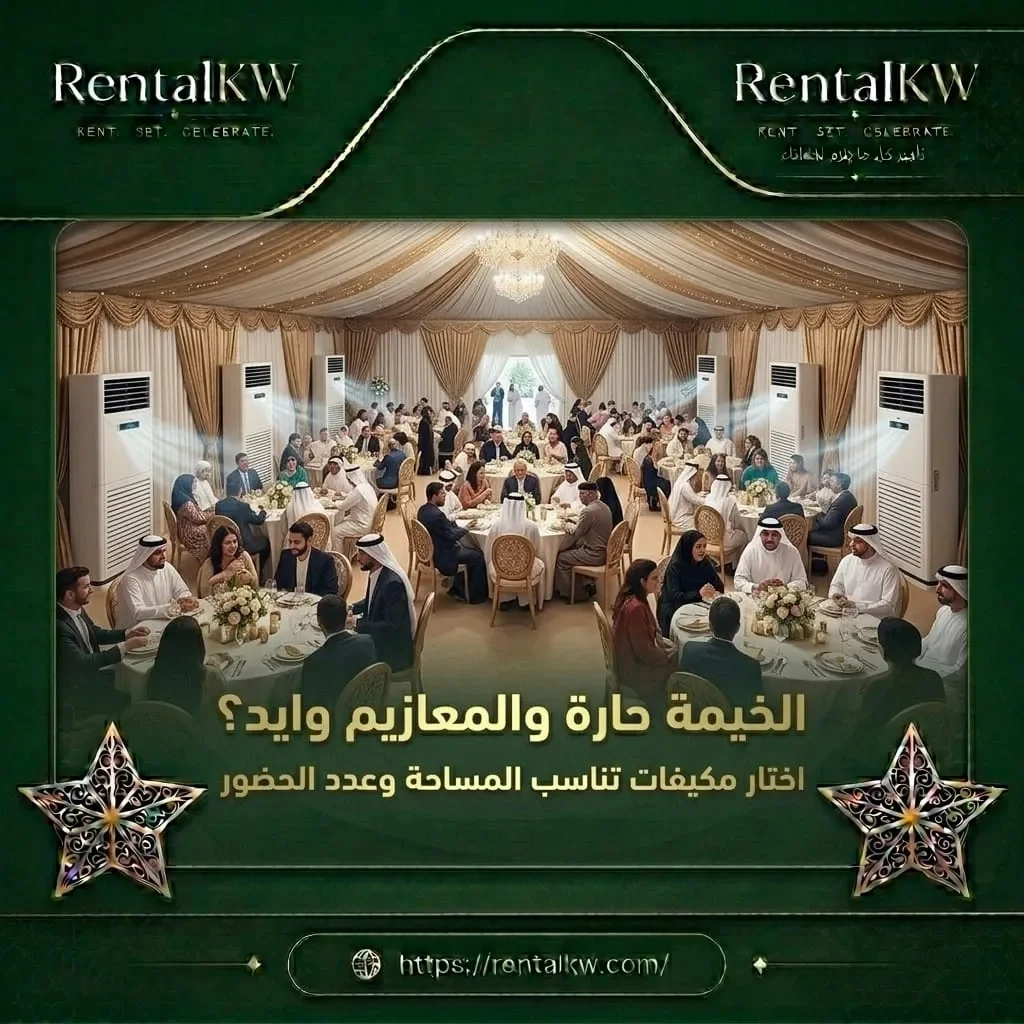
Installing air conditioners inside tents is a fundamental part of cooling performance because even the right equipment can perform poorly when installed in the wrong location. Planning begins before the units are brought in by identifying airflow points, electrical connections, drainage, outdoor-unit locations, and guest circulation routes.
Units should be installed or positioned safely according to the temporary nature of the tent structure. It should never be assumed that any part of the tent frame can support equipment or service lines without confirming the appropriate installation method. The work should therefore be completed by a team familiar with both the equipment and the type of tent being used.
Airflow is another major factor. A curtain or decorative element positioned in front of the unit can restrict cooling distribution, while directing cold air continuously toward a nearby table can make guests uncomfortable. The objective is to deliver air into the occupied zone and allow it to mix in a way that creates balanced comfort.
Openings used for refrigerant lines or air hoses should also be prepared carefully so they do not become major points where hot outdoor air enters the tent.
When installing air conditioners inside tents:
• Confirm equipment locations after reviewing the furniture and decor plan so an AC unit is not installed and later blocked by a curtain screen or decorative feature
• Use installation methods appropriate to the tent structure and equipment specifications rather than placing loads on a temporary frame that was not designed to support them
• Organize electrical cables drainage hoses and cooling lines away from walkways so they do not create obstacles or trip hazards for guests
• Treat openings where service lines pass through the tent sides in a way that reduces hot-air infiltration while preserving the appearance of the interior lining as much as possible
• Direct airflow toward the occupied seating area without creating a strong continuous cold draft on guests sitting close to the unit
• Check drainage cooling performance and electricity after installation and before final decorative work so problems can be corrected without dismantling completed sections of the setup
Booking Tent Air Conditioners in Kuwait
Booking tent air conditioners in Kuwait requires more information than the event date and the number of units requested. If the customer has not already completed a technical cooling calculation, it is better to provide details about the tent and intended use and allow the required capacity to be assessed from those conditions rather than requesting an arbitrary number of air conditioners.
Important information begins with tent dimensions, height, operating time, guest count, event type, location, and whether the structure is exposed to sunlight or shaded. Lighting, internal equipment, and the available electrical supply should also be included.
Rental quotations can then be compared more accurately. A clear quotation should identify the unit types, capacities, quantities, rental duration, and whether transportation, installation, operation, dismantling, and required extensions are included. These details are more useful than the standalone price of an individual air conditioner.
Installation and testing times should also be confirmed. Timely delivery is part of the quality of the service because every cooling system needs enough time to be tested before guests arrive.
Before confirming a booking:
• Provide accurate tent dimensions height guest numbers and event timing so the cooling recommendation is based on real operating conditions
• Explain whether the tent will be exposed to sunlight during the event because solar exposure can significantly change the cooling load
• Request the AC type capacity and number of units to be stated in the quotation rather than accepting a general description that does not clarify the available cooling capacity
• Confirm that the price clearly covers transportation installation operation dismantling extensions and any additional electrical supply that has been agreed upon
• Schedule enough time for system installation and testing before the event instead of arranging for the equipment to arrive immediately before guests enter
• Agree on how operating problems will be handled during the rental period particularly for large events where continued cooling is essential to guest comfort
Conclusion
Successful tent AC rental for summer events depends less on increasing the number of units and more on understanding the venue's real cooling load. Tent size matters, but it is only one part of the calculation alongside sunlight, humidity, guest numbers, lighting, equipment, entrance use, and the level of insulation.
The type of air conditioner must also suit the venue. Evaporative cooling works differently from refrigerant-based air conditioning, and one should not automatically be treated as a direct substitute for the other under every condition. Floor-standing and split units also require proper consideration of heat rejection, electrical supply, drainage, and installation locations before they are used inside a tent.
At weddings and large events, airflow management becomes just as important as total cooling capacity. Distributing units around occupied seating areas, considering guest density, and reducing the loss of cooled air through entrances can make a major difference in comfort.
Outdoor events follow a different cooling logic because cooled air cannot remain contained in an open venue. Focusing on occupied guest zones, shading, wind direction, and cooling technology suited to the weather is more realistic than attempting to air-condition the entire outdoor area.
Electricity is another element that cannot be ignored. A large number of air conditioners requires a properly calculated power source capable of operating the cooling units together with the rest of the event equipment safely and reliably.
Ultimately, the best cooling service begins by collecting accurate site information, calculating the requirement, selecting the appropriate system, planning distribution and installation, and testing performance before guests arrive. This approach prevents customers from paying for more equipment than they need while also avoiding the opposite problem of having a beautifully prepared tent that remains uncomfortable in the summer heat.
Frequently Asked Questions
How is the number of tent air conditioners determined?
The number is determined after considering tent area, height, insulation, solar exposure, guest numbers, lighting, equipment, outdoor temperature, and the type and capacity of the air conditioners rather than using floor area alone.
Are evaporative coolers suitable for every tent?
No. Evaporative cooling performance is affected by humidity and airflow and requires appropriate operating conditions. It may work well for some open or semi-open tents while being less suitable for other situations.
Can a split refrigerant air conditioner be installed in a tent?
Suitable split systems can be used when the indoor and outdoor units, refrigerant lines, electrical connections, and drainage are installed correctly and the cooling capacity is selected according to the tent's actual heat load.
When should wedding tent air conditioners be switched on?
The cooling system should generally be started early enough before guests arrive to reduce the tent temperature and test airflow distribution. The exact timing depends on venue size, system type, and outdoor conditions.
Do large tents simply need more air conditioners?
Larger areas generally increase cooling requirements, but the solution is not limited to adding more units. Large tents also need properly distributed capacity, planned airflow, cooling zones, and an adequate electrical supply.
What is the difference between cooling a tent and an outdoor event?
Cooled air can be retained more effectively inside an enclosed tent, while it disperses rapidly outdoors. Outdoor cooling therefore usually focuses on occupied guest zones, shading, and airflow direction.
Can tent air conditioners run on any electrical supply?
No. The cooling equipment and all other event loads should be calculated and matched with the available circuits, electrical source, or generator so the units can operate safely and reliably.
What information is needed before booking tent air conditioners?
It is useful to provide the tent dimensions, height, guest count, event time, level of enclosure, solar exposure, internal equipment, and available electrical supply so the cooling system can be selected according to the actual requirements.